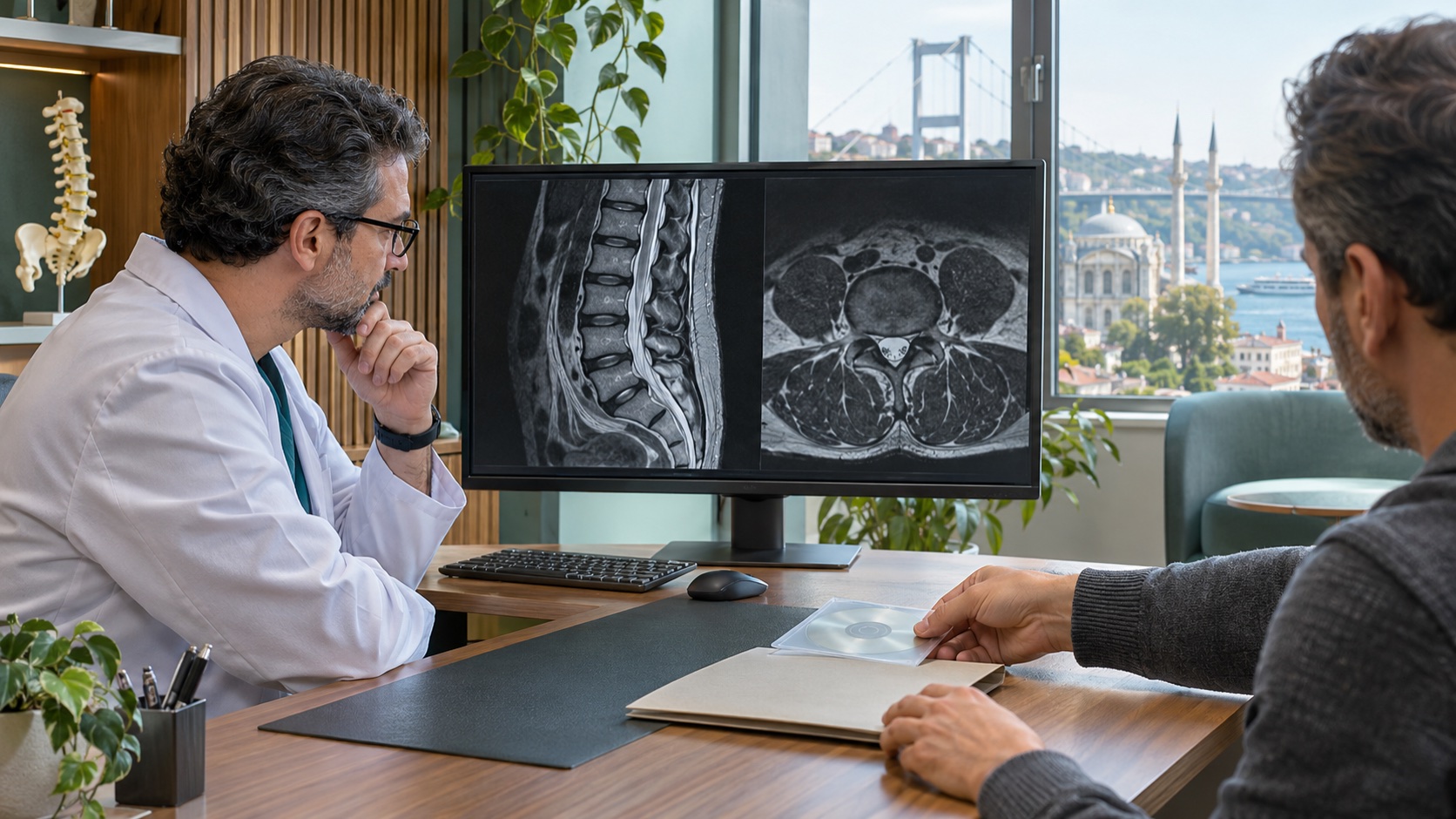
If you have been offered spine surgery, start a second opinion with three things: the question you want answered, the original images on which the recommendation was based and a short account of what has happened since. Send the radiologist’s report alongside the images. Include the surgeon’s letter if you have it. A reviewer needs to understand both what the first surgeon saw and what problem you hope an operation would solve. 1, 2
For example, “Do I need a fusion?” is a reasonable starting point. It becomes easier to answer when the specialist knows that your main difficulty is standing to cook, that sitting relieves the leg pain, and that a two-level operation has been proposed. Someone with the same MRI description whose main concern is new foot weakness needs a different conversation. This guide explains how to prepare for a planned consultation and how to recognise changes that need attention closer to home.
First decide whether it is safe to wait
With back or leg symptoms, new difficulty starting or controlling urination, loss of awareness of bladder filling, numbness around the genitals or bottom, or a new loss of bowel control can indicate pressure on the nerves called the cauda equina. Seek emergency assessment locally rather than waiting for a remote opinion or a flight. You can still pass some urine and have a serious problem. Tell the emergency team when the change began and what your normal bladder or bowel function was beforehand. 6
Spinal cord problems in the neck can affect the hands and legs together. New trouble using buttons, dropping objects, walking unsteadily or falling deserves clinical assessment, especially if several changes occur together. Rapidly worsening weakness or walking difficulty warrants urgent local assessment. Neck pain can be modest. A family member’s observation that you now need the banister may convey a change that a pain score misses. For more about this pattern, see Cervical spinal stenosis and myelopathy. 7
If a surgeon has advised urgent treatment, ask the treating team immediately whether another opinion can safely be obtained within the available time. A message that a file has been received is an administrative acknowledgement. It gives no assurance that a clinician has assessed urgency. A new symptom after a recent examination is a reason to contact the team again, even if your scheduled video appointment is only a few days away. 6, 7
Write a one-page history that a surgeon can use
Begin with the symptom that most limits your day. Describe where it starts, which side it affects and where it travels. Separate pain, tingling, loss of sensation and loss of strength. “My right toes catch the floor when I walk” is more informative than “my leg is bad.” For neck symptoms, distinguish shoulder pain, pain travelling below the elbow and difficulty handling small objects. If different symptoms started at different times, give each its own place in the history.
Use three or four dates that change the story. State when you first noticed the problem, when it affected an important activity, when the scan was taken and what has changed since. Exact dates are helpful for operations and investigations. Approximate dates are perfectly useful for gradual symptoms if you label them as such. Describe an ordinary week, including what reliably provokes symptoms, what eases them and how long improvement lasts. Avoid testing a painful or unsafe movement just to make a more precise report.
Choose one or two goals against which to judge a recommendation. Walking from the car to the shop without stopping, holding a pen for a full page, caring for a child or sleeping without arm pain are different priorities. If you need a walking aid because of a hip problem, say so. A surgeon assessing walking distance needs to know which limitation you would still have after successful treatment of a spinal nerve. Improvement in one symptom may leave another largely unchanged.
Add the latest clinical examination if available. A note recording muscle strength on each side, sensation, reflexes and walking ability gives the reader a baseline. Include the examination date. A normal examination from six months ago can be useful history while offering little reassurance about weakness that started last weekend. If pain stopped you from completing a test, mention that. You are not expected to grade your own strength, provoke symptoms or ask a relative to examine your reflexes.
Ask the imaging centre for the complete examination
Request a copy of the original diagnostic images in DICOM format and the final radiology report for each relevant examination. DICOM is the standard format in which medical images and information about the examination travel together. Depending on the centre, you may receive a secure sharing link, a downloaded folder or a disc. The patient portal may display the report before the images are available for export. Ask the radiology department or medical records team which route lets another clinician review the entire study. 1
A useful request is: “Please provide the complete lumbar MRI from 12 October, including all series and the final written report, for review by another specialist.” Substitute the actual region and date. If an addendum corrected the first report, include both the final version and the clarification. If your neck and lower back were scanned on the same day, check which examination is in the folder. A receipt for two scans does not establish that both sets of images were exported. 1, 2
A photograph of a monitor, a printed sheet or a PDF containing a few selected views may help a coordinator identify the examination. Diagnostic review often requires scrolling through neighbouring slices, comparing more than one sequence and looking at the same structure in a different plane. A picture showing the middle of the canal may miss the opening through which a nerve exits. Keep the original directory and its contents together. If you can already see the report, check separately that the intended recipient can open the images. 1, 2
If there are several examinations, include a simple index. List the date written out in words where day and month could be confused, the facility, the region examined and whether it was before or after treatment. Point out the examination on which the current surgical proposal was based. An older study can sometimes explain what was already present during a period when you felt well. Comparing dates can also show that the latest scan predates the symptom now causing concern. 1
What MRI, CT and standing radiographs contribute
MRI shows discs, the spinal cord, nerve roots and other soft tissues in detail. It can help the specialist judge whether the place and side of a narrowing fit your symptoms. An MRI report may describe wear at several levels. The most striking wording in that report does not establish which level needs treatment. Ask the specialist to show you the finding that best explains your particular loss of function and to identify findings that can be observed. 2, 4
CT gives particularly useful detail about bone. It may answer a question about a fracture, the position of surgical hardware or the bony anatomy relevant to a proposed approach. Because CT uses X-rays, a new scan should answer a defined question. If a clinician requests one after reviewing your MRI, ask what decision depends on it and whether an existing CT already covers that area. Someone evaluating a nerve or the spinal cord may still need information that a CT alone cannot supply. 2, 3, 4
Standing radiographs can show alignment under load. In scoliosis, the team may want the full spine viewed from the front or back and from the side, along with earlier comparable films. A routine MRI obtained lying down answers a different question. In a growing child, mention changes in height, when bracing began and whether the radiograph was taken wearing the brace. In an adult, explain whether standing upright or looking straight ahead has become more difficult. 8
Contrast is chosen for a particular clinical reason. For example, the question after earlier surgery or when infection is suspected can differ from the question in uncomplicated nerve pain. Do not arrange contrast solely because the review is international. Tell the imaging team about implants or devices, previous reactions, relevant kidney problems and possible pregnancy. If MRI is unsuitable or inconclusive, a specialist may consider CT myelography in selected cases. It involves a spinal needle, contrast and X-rays; its additional information must justify those burdens. 2, 4, 5
Tailor the file to the decision in front of you
For pain travelling down an arm or a leg, give the side and the area most affected. Include whether an episode of weakness occurred before or after the scan. If you were offered an injection, supply the procedure note if it exists, identifying the side, level and purpose. Explain what improved, by how much in everyday terms and for how long. Several hours of relief followed by the return of leg pain tells a different story from several months of easier walking. The result is one piece of evidence.
For suspected spinal stenosis, describe the distance or time you can walk on level ground, what makes you stop and whether sitting changes the symptoms. Mention other reasons for stopping, such as breathlessness or a painful knee. If the proposal combines nerve decompression with fusion, request the explanation for each part. Which symptom is decompression intended to address? What evidence suggests that stabilisation adds a benefit in your particular case? Ask what could change that recommendation after examination.
For an adolescent with scoliosis, assemble the dated standing radiographs, measurements if reported, growth and brace history, and the recommendation given to the family. The precise curve pattern and remaining growth influence what the team will discuss. An early-onset, congenital or neuromuscular curve can require different information, including earlier developmental assessments, underlying diagnoses and respiratory history where relevant. Parents can include the young person’s priorities about school, comfort and activity alongside their own questions about the proposed treatment. 8
For persistent symptoms after surgery, distinguish symptoms that never improved from symptoms that returned after a period of relief. Record any entirely new symptom separately. A disc operation, decompression and instrumented fusion change the anatomy in different ways. Include the operation report with levels, side and approach, the discharge summary, relevant imaging before and after surgery, and details of complications or further procedures. If the previous surgeon explained why an additional level was left untreated, include that letter. 2, 3, 4
An implant card or manufacturer’s description may help the imaging team identify a device. If you have a stimulator or another electronic implant, tell the team before an MRI is arranged. The imaging provider must verify the model and scanning conditions. A previous uneventful MRI is not a substitute for that check. Where infection or a tumour has influenced a plan, send the relevant microbiology or pathology report and treatment dates. Ask before sending physical specimens or unrelated hospital records. 2, 4
Record what treatment has already achieved
For each treatment you have tried, note approximately when it started, what it was meant to improve and why it ended. “Six supervised sessions, easier walking for the first month, then increasing calf pain” offers more context than “physiotherapy failed.” Describe home exercises or activity adaptations if they were part of the plan. Mention a treatment you could not access or tolerate. Having had no opportunity to try an option is different from trying it without benefit.
Provide an up-to-date medication list, including nonprescription medicines and supplements where relevant. Use the active ingredient as well as the brand if you know it, since brands can differ between countries. Include allergies and what reaction occurred. Flag anticoagulants, immune-suppressing medication and significant heart, lung or bone conditions. Do not change a medicine to prepare for a records review. If an operation is eventually planned, the responsible clinicians can give specific instructions in light of your health and procedure.
If the first team offered surgery, attach its letter and any diagrams or written explanation that identify the procedure. If you received only a verbal recommendation, record your understanding and identify it as your recollection. A phrase such as “clean out the nerve” may refer to different procedures. Ask which level, side and structures the surgeon meant. If two reports number a level differently, send both originals and flag the discrepancy. The clinical team must reconcile the anatomy before any intervention.
Transfer records and arrange the consultation in Istanbul
Contact Recmed through its official contact page and ask which receiving team and transfer method to use. In the first enquiry, state the decision you need help with, preferred language, country and a reliable way to reach you. Confirm how imaging can be shared, who may access it and when the link expires. Keep an original copy. A public posting, an unrestricted folder or a link requiring your personal portal password can create problems for patient privacy and for the person trying to open it. 1, 9
If you are organising the review for another adult, agree that they want the specified records shared and ask how the receiving team documents permission. For a child, confirm guardian requirements. Provide identifiers through the agreed channel so files can be matched safely. Keep the original report in its original language alongside a translation. For example, a translated summary that accidentally reverses left and right can change the apparent relationship between symptoms and images. Flag uncertainties explicitly.
Ask for confirmation that the intended examination can be opened and that the relevant documents arrived. Then clarify who will review the file, whether an appointment is included, the language of any written opinion, the fee if applicable and how follow-up questions are handled. A transfer receipt and a completed medical opinion are separate events. If an Istanbul visit is advised, first clarify its purpose, which tests require attendance and which decisions remain provisional. Plan a spine consultation in Turkey. Request an assessment in Istanbul. 9
Use the second opinion to make a decision
Ask the reviewer to describe the most likely explanation, the evidence supporting it and any competing explanation worth checking. For each option, identify the specific benefit, its limitations and the important risks for you. A procedure may aim to prevent further neurological decline while offering uncertain recovery of longstanding numbness. Ask what observation or rehabilitation would involve, who would monitor progress and what change would prompt a fresh examination. A useful recommendation states what to do next even when the answer is to defer surgery. 4, 7
If two surgeons disagree, compare the assumptions behind their proposals. They may be treating different symptoms, working from different images or estimating different risks of later deterioration. Ask each to explain the smallest operation they consider adequate and the reason for any additional levels or implants. Write down which finding would cause them to change their view. Once the medical scope is clear, compare quotations describing the same levels, procedures and aftercare arrangements. Compare written spine surgery quotations.
Before ending a remote review, agree which conclusions can responsibly be made from the documents and which require a physical examination. A video discussion can reveal how you describe symptoms or use your hands, but strength against resistance, reflexes and some sensory findings need an examiner. Ask for a written summary you can give your local clinician and permission before recording a consultation. Decide who will review a missing study and how new symptoms should be reported between appointments. 7
Work through a disagreement one question at a time
Imagine that one surgeon has proposed removing tissue pressing on a single nerve, while another has recommended joining two vertebrae as well. Bring both letters and ask each reviewer to mark the level on the same set of images. Then ask whether the concern about movement comes from symptoms, standing images, the amount of bone that may need removal or a combination of findings. Those are different reasons for considering a larger operation. The answers may explain a disagreement without either clinician having misread the MRI.
Keep a short decision record after the appointment. Write the chosen next step, the person responsible, the reason for it and the date or symptom that should prompt review. If the plan is to obtain a new examination locally, find out who will see the result and how to arrange a discussion. If the recommendation is to continue nonsurgical care, ask which everyday activity you should use to judge progress. The value of a second opinion can lie in a clearer plan for the coming weeks even when no procedure is booked.
Common questions about a spine surgery second opinion
Is there a rule about how recent my MRI must be?
There is no single useful expiry date for every clinical question. Tell the specialist when your symptoms changed relative to the scan. Images that predate a new neurological problem may be insufficient, while an older study can remain valuable for comparison. Start with what you already have and ask what an updated examination would change. Seek local assessment promptly if the change is urgent. 1, 4, 6
What if I only have the report and cannot obtain the images today?
Send a brief inventory of what you have and explain which files are outstanding. A clinician may be able to frame questions from the report, although a decision about a level or procedure can remain open. Ask the imaging centre about an export or external sharing link. Do not surrender your only copy of a disc without arranging a replacement. 1
Can I request a second opinion before agreeing to another fusion?
Yes, provided the timing is medically safe. Send the first operative report, dates of relief or deterioration, images from before and after treatment and the current proposal. Ask whether the recommendation addresses persistent compression, instability, deformity or another problem. Then ask which part of your present difficulty each component of the proposed operation is likely to improve. 3, 4
What should I take back to my own doctor?
Take the written opinion, a list of the images reviewed by date and any questions the remote reviewer could not settle. Ask your own doctor to check changes in strength, walking or sensation and to discuss what follow-up is feasible where you live. If you decide to travel, keep the name of the team responsible for care before departure and after return. That makes the second opinion part of a continuing treatment plan.
Preparing a second opinion for a young child? See our guide to early-onset scoliosis and growth-preserving treatment.