If you are considering a second spine operation, start with what happened between the first operation and today. Did the original leg pain disappear and then come back? Did the pain settle while a numb foot stayed numb? Or did something entirely new appear on the other side? Those are three different histories. A new scan can help investigate each one, but a surgeon needs the sequence of events to judge which finding matters. Bring the images from before the first operation as well as the latest study. 1, 3, 4
Revision spine surgery means operating again on a region that has previously been treated. It can mean removing another disc fragment, freeing a nerve that remains compressed, repairing a fusion that has not healed, or treating a problem next to an earlier fusion. Sometimes the most useful result of a revision consultation is a rehabilitation plan and an explanation of why another operation is unlikely to help. This guide focuses on adults after lower back surgery. New weakness in the hands, loss of balance or difficulty walking after neck surgery also needs prompt assessment by your own team. 1, 4, 6, 7, 9
Which changes need help today?
After a back operation, seek emergency assessment for new difficulty passing urine, loss of bladder or bowel control, numbness around the genitals or anus, or new or rapidly worsening leg weakness. Tell the emergency team what operation you had and when. A foot that suddenly will not lift or legs that have become too weak to support you are important changes. Do not wait for every symptom to appear together. Sudden chest pain or severe breathlessness after surgery also needs emergency help. Use the emergency service where you are. 1, 2, 8
Contact the surgical service promptly about a wound that is opening, draining or becoming increasingly red, fever with worsening back pain, or a severe headache that is much worse upright after a recent procedure. These problems need individual advice and sometimes urgent examination. If you are very unwell or symptoms are rapidly progressing, seek emergency care locally. A photograph or message can help a team arrange follow-up, but it cannot assess strength, circulation or the deeper tissues around an incision. Postpone plans to travel for a second opinion until an urgent problem has been assessed. 1, 2, 8
Reconstructing the first operation
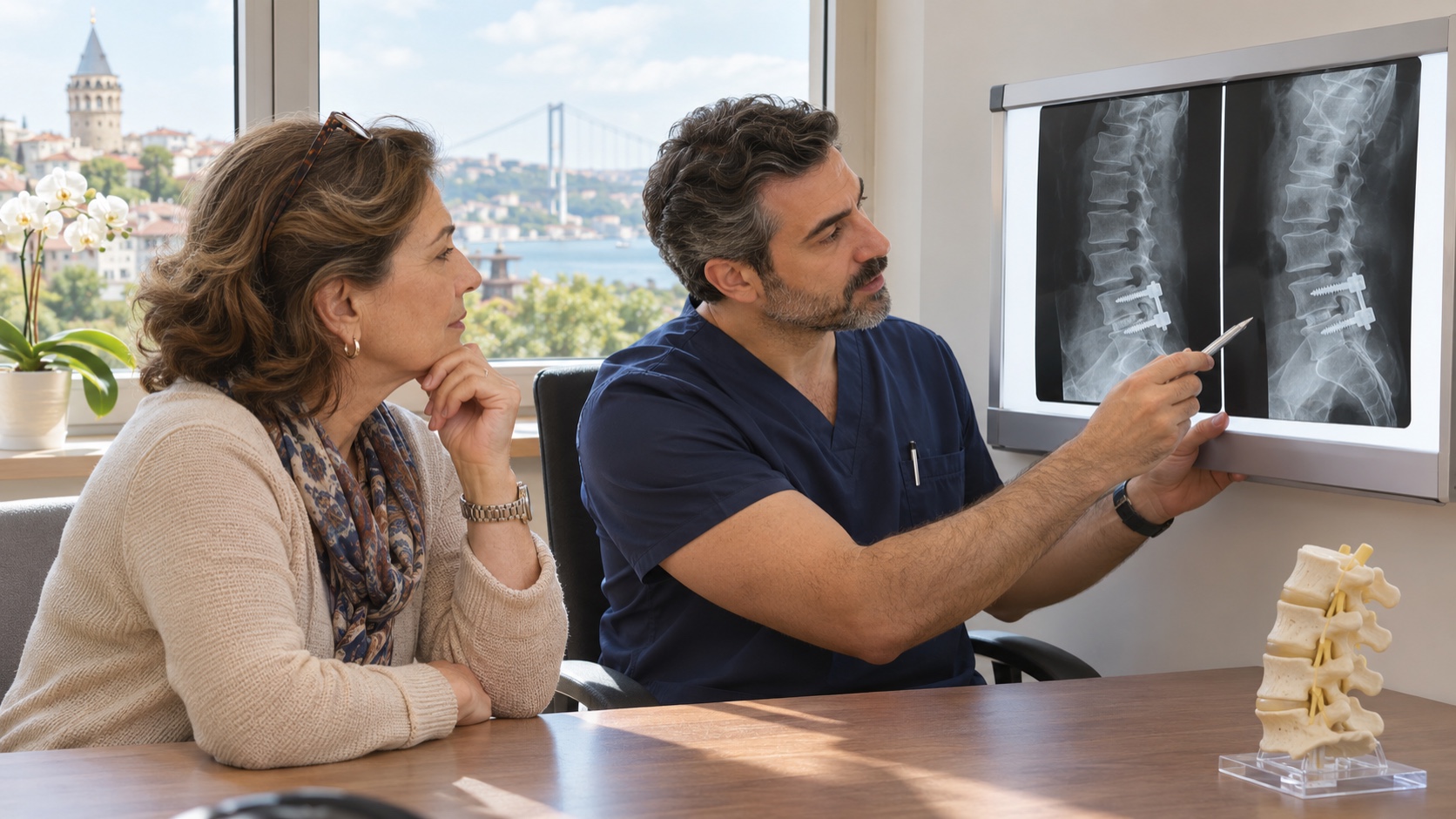
Start with the name of the operation, the date, the side and the vertebral levels involved. A discectomy removes disc material pressing on a nerve. A decompression creates more room for neural structures. A fusion aims to join selected bones, often holding them still with screws, rods or a cage while bone grows across the intended space. These operations address different problems. Someone who had a small disc fragment removed needs a different review from someone who had several levels fused to correct deformity. Your scar does not tell the whole story. 1, 4, 6
Ask for the operation report, discharge summary and any implant record. If surgery took place abroad, keep the documents in the original language and add a translation if available. A short note saying “lumbar surgery” may omit whether the surgeon removed part of a facet joint, which side was approached, or why a level was left alone. Those details can affect whether a new decompression is feasible. If you cannot obtain the report, tell the new clinic which records are missing. It can explain which decisions can still be made from the examination and images. 3, 6
Make a one-page timeline. Record the activity you struggled with before surgery, the first improvement you noticed, your best period afterwards and the date of the latest change. For example, you might have gone from stopping twice on the way to the bus to walking the whole route, then developed pain in the opposite calf six months later. The return of a disability can be measured even if you cannot give pain a precise number. Include episodes of fever, a fall or a wound problem if they occurred. Avoid guessing what caused the change.
Persistent pain, recurrent pain and new symptoms
Persistent symptoms have continued since surgery. A patient may say the operation did nothing, yet on closer questioning the shooting pain resolved while longstanding numbness remained. Nerves recover at different rates, and longstanding injury can leave an altered sensation even after pressure is relieved. The next question is whether the present problem is improving, stable or progressively reducing function. A new loss of strength merits earlier review than a stable patch of numbness. At the appointment, ask which symptoms the original operation was expected to change. 1, 2, 9
Recurrent symptoms return after a period of improvement. After a discectomy, disc material can again press on the same nerve. Symptoms can also arise from another level, a narrowing of the opening through which the nerve leaves the spine, or a problem outside the back. You do not have to identify the source before asking for help. It is useful to describe precisely where the symptoms start, how far they travel, which movements bring them on and how much time passes before they settle when you change position. 3, 4
New symptoms deserve their own description. Groin pain getting out of a car, numb toes on both sides, or pain in the calf during walking may require consideration of the hip, peripheral nerves or circulation. A change on a spinal scan can coexist with any of these. Tell the clinician about diabetes, vascular disease, previous hip surgery and medicines that affect balance. A useful examination may include hip movement or pulses as well as strength, reflexes and sensation. The question is what explains the difficulty you are experiencing now. 3, 9
What each scan can answer
MRI can show the canal, discs, nerve roots and surrounding soft tissues. In someone with new or worsening symptoms after lower back surgery, MRI with or without contrast and ordinary radiographs can be appropriate, depending on the question. Contrast can help distinguish postoperative scar from recurrent disc material or assess suspected infection. The radiologist takes account of the operation, timing, earlier images and personal safety considerations. Tell the team about kidney disease, previous contrast reactions and implanted devices. Avoid ordering a specific contrast study yourself before the clinical question has been reviewed. 3
CT gives detailed information about bone and the position of metalwork. If a fusion is in question, the surgeon can look for bridging bone and compare the result with the intended operation. A review of diagnostic studies found CT particularly informative for assessing nonunion after thoracolumbar fusion, while noting limitations in the underlying studies. A report describing incomplete bridging does not, on its own, prove that this is the source of pain. The time since surgery matters. Ask which part of the fusion is being assessed, how mature it should be and whether a further image would change management. 5, 6
Standing radiographs show the relationship between vertebrae under load. Selected patients may need bending views to investigate motion or longer standing films to assess overall alignment. These studies answer different questions from a scan taken lying down. Metal can obscure tissue on MRI, so the imaging team may adapt the sequence or consider another test. Sending original digital images allows the surgeon to examine multiple slices and compare the same level across dates. A photograph of the report or a single image on your phone rarely offers that opportunity. 3, 5, 6
If a disc herniation has come back
A recurrent disc herniation becomes a surgical question when its position fits the symptoms and examination. A second disc fragment on the left does not neatly explain new right-sided pain. A fragment seen during a scan obtained for another reason may cause no symptoms. Conversely, a relatively small fragment can matter if it compresses the nerve that supplies a newly weak muscle. Ask the surgeon to show you the affected nerve and explain which part of your history makes this finding important. A match between the side, level and clinical findings is more informative than the word “large.” 3, 4
If function is stable, the team may discuss continuing nonsurgical treatment with a date for reassessment. If disabling nerve pain persists in spite of appropriate treatment or strength deteriorates, repeat discectomy may enter the discussion. Its main aim is to relieve compression of a particular nerve. Ask what it could reasonably do for your leg pain, what it might do for weakness, and what it is unlikely to change about back pain. These are separate outcomes. A surgeon can be reasonably confident about the first while remaining uncertain about the others. 1, 4
Fusion is sometimes proposed alongside repeat decompression. For recurrent lumbar disc herniation, the WFNS Spine Committee advises against adding fusion routinely. Instability or deformity can change the decision. Ask whether abnormal movement is already present, or whether removing the bone needed to free the nerve would create instability. Ask which levels would be joined and what an operation without fusion would leave unresolved. If two surgeons recommend different approaches, compare the assumptions behind the proposals. They may agree about the compressed nerve and disagree only about whether the segment would remain stable. 4, 6
Nonunion, hardware and the level next to a fusion
Pseudarthrosis, also called nonunion, means a solid bony connection has not formed where fusion was intended. Some people have few symptoms. Others have persistent mechanical pain, loss of alignment or difficulty related to loose or broken implants. Before discussing another fusion, the team will want to know how long healing has had, whether the symptoms fit the level involved and whether another source is more plausible. The word “nonunion” is a reason to examine the evidence closely. It does not establish how much a particular person would gain from revision surgery. 5, 6
A screw or rod can look different on a later film for several reasons. Apparent changes can reflect how the patient was positioned, while genuine movement, loosening or breakage can point to excess load or inadequate bone support. Ask to see the comparison with an image taken shortly after surgery. If hardware removal is proposed, ask whether the fusion underneath it is solid and how the team would maintain stability if it is not. Replacing metal without identifying why the construct failed may leave the original mechanical problem unresolved. 5, 6
Adjacent segment degeneration describes changes on imaging above or below a fusion. Adjacent segment disease means that changes at a neighbouring level are clinically relevant. For example, someone who regained the ability to walk after a fusion may later develop leg heaviness on standing, with narrowing at the level above. The pattern, examination and images together help determine whether the neighbouring level explains the change. A worn-looking disc by itself is insufficient. Ask whether treatment could focus on that level, whether it would require extending the fusion, and what evidence supports the difference. 7
When another operation is unlikely to improve pain
A patient may have entirely real, disabling pain without a compression or unstable segment that can be corrected. Previous nerve injury, sensitivity of the nervous system, deconditioning or more than one source of pain can contribute. A term such as “failed back surgery syndrome” describes an experience, but says relatively little about what should happen next. Ask for a more specific explanation, including what the team believes it has excluded, what remains uncertain and which observation would prompt it to revisit the decision. A clear plan should give the patient somewhere to go after the consultation. 9
Rehabilitation may combine graded activity, work on strength and balance, help with sleep, and review of medicines that cause dizziness or offer little benefit. A pain service may discuss additional approaches for selected patients. The plan should take account of restrictions from your operation and agree on a practical goal. Being able to sit through a meal or walk to a nearby shop may be easier to track than an average pain score. Establish who will review progress and what should trigger earlier reassessment. New neurological changes still require clinical attention during rehabilitation. 2, 8, 9
Weighing a revision proposal
Ask the surgeon to finish a simple sentence in everyday language. “We propose changing this part of your spine because we believe it is causing this particular difficulty.” Then ask what remains uncertain. A decompression may have a reasonably clear target for radiating pain but offer less certainty for pain in the centre of the back. Repairing a nonunion may improve mechanical stability without restoring lost sensation. Understanding these distinctions is particularly important when a report describes several abnormalities, only one of which the proposed operation would address. 1, 4, 6, 9
A previous operation can leave scar tissue around nerves and the protective membrane that contains spinal fluid. Revision may therefore carry a different risk of a tear in that membrane, fluid leakage or nerve injury. Other considerations include infection, bleeding, failure to unite, persistent symptoms and the possibility of further surgery. Ask how the team would handle an unexpected finding, such as loose fixation or tissue suspicious for infection. Discuss whether it might change the operation, the length of stay or the timing of a return flight. Individual estimates should come from the team that knows your anatomy and medical history. 1, 2, 6
Bone health, tobacco or nicotine use, nutrition and diabetes management can matter when another fusion is proposed. Be candid about medications, previous fractures and difficulties healing after earlier procedures. If the team recommends postponing elective revision to improve an aspect of health, ask how progress will be assessed and what symptoms would change the timing. A person with rapidly worsening weakness faces a different decision from someone with stable pain who can prepare for an elective reconstruction. Do not stop an anticoagulant or alter prescribed medication without advice from the responsible clinicians. 1, 6, 8
Recovery, follow-up and travel to Istanbul
Plan recovery around the proposed intervention. A repeat removal of a disc fragment and a multilevel reconstruction place different demands on mobility, wound care, pain control and help at home. Ask what the team expects you to manage before discharge, including stairs if your home requires them. Clarify restrictions on lifting, driving, prolonged sitting and work. Give the surgeon a description of your actual journey and job. Lifting trays throughout a shift or driving a delivery van is a different challenge from working at a desk for brief periods. 1, 2, 8
If seeking a second opinion through Recmed in Istanbul, prepare the operation and implant records, dated scans in their original format, the recovery timeline and one or two decisions you want help with. Recmed can coordinate an appointment and interpretation. The treating specialist decides whether the existing information is sufficient, whether an in-person examination is necessary and whether intervention is appropriate. If you already have a local surgeon, arrange for them to receive the written opinion. You can use our consultation request form to ask how to transfer the records securely. 10
Request a written estimate tied to the proposed levels and procedure. Clarify whether it covers new implants, removal of existing implants, imaging, hospital care, rehabilitation and follow-up. Ask which findings could change the estimate and who will present the revised plan. Before leaving Istanbul, obtain the operation report, implant details, discharge instructions and the next review date. Agree who will examine the wound near home and where to go for urgent symptoms. A remote appointment can answer many follow-up questions, but it cannot manage every wound or neurological problem. 2, 8
Questions worth taking to the consultation
I improved after surgery, then the same leg pain returned. Is this definitely another hernia?
A new herniation is one possibility after disc surgery. The interval of improvement is useful evidence, as is the exact route the pain follows. The clinician will compare that history with an examination and appropriate imaging. Take the earlier scan too. A report from before the operation and one from today can use similar wording while referring to findings at different levels. If the new episode includes weakness, saddle numbness or bladder changes, seek urgent local assessment. 2, 3, 4
Does scar tissue on MRI mean it should be removed?
Scar can be part of ordinary healing and may appear on imaging in people who have few symptoms. The surgeon needs evidence that a specific problem amenable to treatment explains your difficulty. Ask what benefit is expected from an operation directed at the scar, how likely it is to help your main symptom and what other explanations have been considered. A review that concludes that surgery is unlikely to help should still offer a concrete next step for pain, function and future monitoring. 3, 9
How can I compare two opinions about extending a fusion?
Give both teams the same images and operative report. Ask each to identify the symptomatic level, the evidence of instability or deformity, the proposed extent of fixation and the consequence of leaving an adjacent level mobile. Compare expected effects on the activities that matter to you. If the recommendations differ because one surgeon lacks an image or assumes a prior level has fused, clarify that point before comparing the operations themselves. For background, see our spinal fusion guide and our guide to obtaining a spine surgery second opinion. 5, 6, 7
What would make observation a reasonable choice?
Ask the clinician what has been ruled out, which symptoms are stable, what treatment will support function and when reassessment is due. Write down the changes that would trigger an earlier visit. A plan to continue rehabilitation while measuring walking distance is different from being told simply to wait. You should leave knowing who will review the result, how to reach them and what to do if a new symptom develops before the appointment. 1, 2, 9
Which information should I record between this visit and the next?
Choose one activity that matters and that you can repeat safely. If walking is the issue, note the route, when symptoms begin, which side is affected and whether a short rest lets you continue. If sitting is the issue, record when you need to change position and whether the pain spreads into a leg. Keep notes on a handful of representative days rather than testing yourself to exhaustion. Describe medication changes alongside the observations. A longer walk on a day when someone carried your bag can still be an improvement, but the circumstances help your clinician interpret it.
If you are trying a change in rehabilitation, ask what it is intended to improve and how the result will be judged. Do you want to stand at the sink long enough to wash dishes, or regain confidence going downstairs? These goals can require different exercises and different adjustments at home. At the next appointment, show what has improved and what still stops you. The review can then address the remaining problem rather than repeating the original history. 2, 8, 9
Should I keep an appointment with my original surgeon if I seek a second opinion?
Continuity can be useful. The original team knows what was found during the operation and may be able to explain a detail missing from the report. Ask the second team to put its reasoning and suggested follow-up in writing so that both can work from the same information. Agree which service is responsible for urgent problems and which will review later images. This matters especially when the operation took place in another country or when different clinicians are managing pain and surgical follow-up.