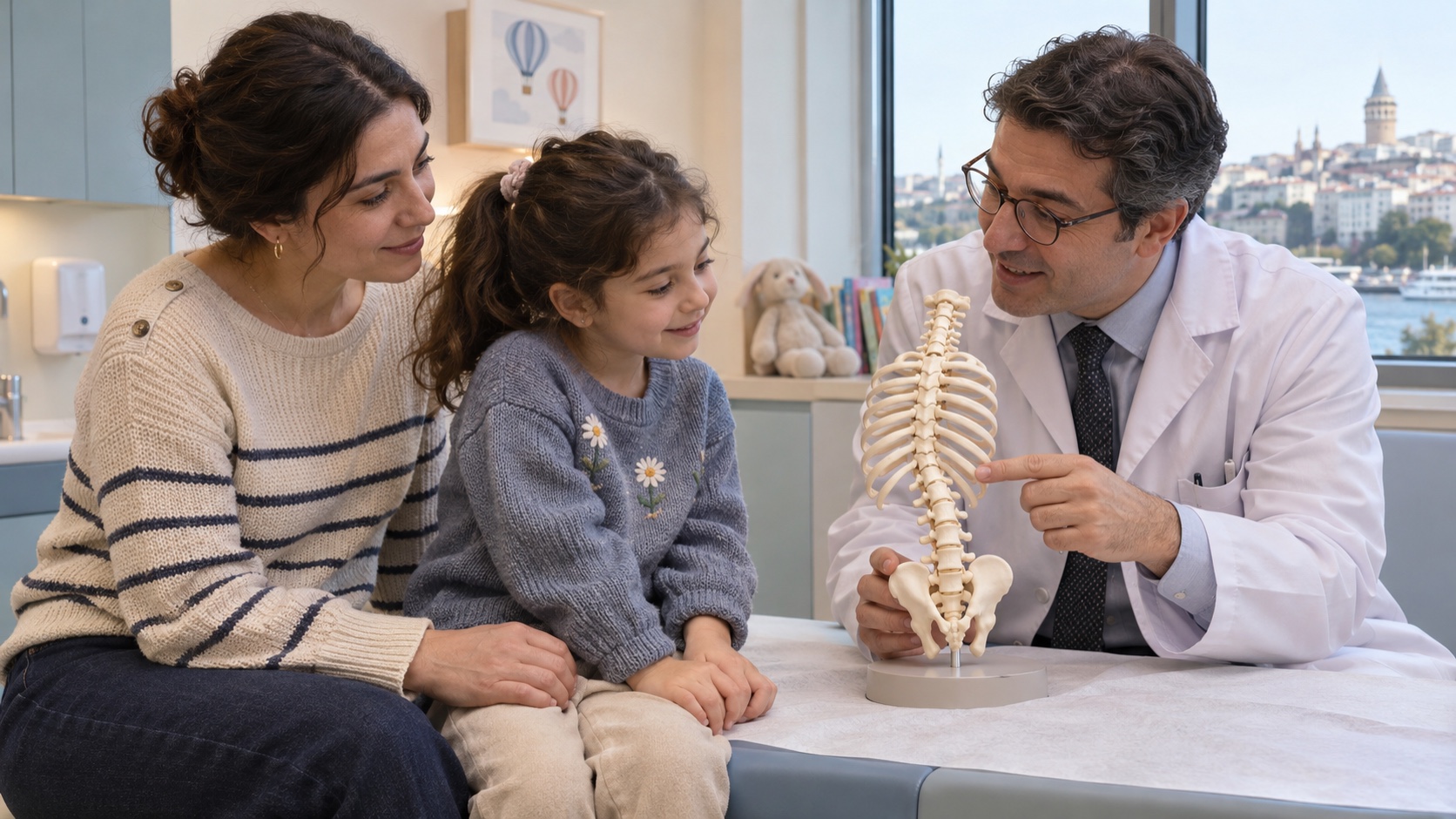
A scoliosis diagnosis in a young child raises two questions. Is the curve likely to worsen as the child grows, and what would treatment make possible in the child's daily life? For one family, the immediate decision is whether to start a series of casts. For another, it is how to help a child sit comfortably in a wheelchair through a school day. The same measurement on an X-ray can lead to different advice. Age, the cause of the curve, the shape of the chest and the child's health all change the decision. 1, 2, 3
This guide is for families whose child developed a persistent spinal curve before age ten, and for those weighing treatment for congenital or neuromuscular scoliosis. It explains what to ask at the first visit, how to judge whether a plan is working, and what follow-up would involve if treatment takes place in Istanbul.
What the diagnosis tells you about your child
Early-onset scoliosis describes when a curve appeared. Congenital and neuromuscular scoliosis describe why it developed. A child can therefore have both early-onset and congenital scoliosis. Another child may first develop a neuromuscular curve in adolescence. When the age of onset is uncertain, take the earliest available images to the appointment. They can show whether a small curve was present before anyone noticed a change in posture. 1, 4, 5
In idiopathic scoliosis, assessment has found no underlying cause. Some curves that begin in infancy improve as the child grows. Others progress, and the distinction may only become clear on follow-up. In congenital scoliosis, one or more vertebrae formed differently before birth. A wedge-shaped vertebra or a bridge of bone down one side can make one side of the spine grow faster than the other. Doctors look at how the bones are arranged and where healthy growth remains. 1, 4
In neuromuscular scoliosis, a condition affecting the brain, spinal cord, nerves or muscles changes the way the trunk is supported. Examples include cerebral palsy, spinal muscular atrophy and muscular dystrophy. The curve may involve a long part of the spine and tilt the pelvis, so one side of the seat bears more pressure. A child who walks may have different priorities from one who needs help with all transfers. A syndromic curve is another possibility when scoliosis is part of a broader genetic or developmental condition. 1, 5
Why growth of the chest matters
A young child's ribs and spine help the chest develop around the lungs. A severe deformity of the chest or spine can restrict that growth or the movement needed for breathing. The term thoracic insufficiency syndrome describes a chest that cannot adequately support breathing or lung growth. A visible rib prominence alone does not establish this diagnosis. Some children breathe comfortably at rest but struggle with activity or infections. Others already need respiratory support because of their underlying condition. 1, 2, 6
Tell the team what breathing is like on a typical day and night. Does your child get breathless during an activity they previously enjoyed? Has the respiratory team changed the child's cough assistance or overnight support? Has there been a recent admission with a chest infection? These observations help the team decide whether respiratory assessment would change the treatment or anaesthetic plan. If a child is struggling to breathe now, seek emergency help locally. A planned spine consultation can wait. 2, 5
An extensive fusion permanently stops movement and growth across the joined vertebrae. That trade-off matters particularly in the middle of a very young child's back, where the ribs attach. Yet a short fusion in a carefully selected congenital curve can protect growth elsewhere by preventing a small, sharply angulated curve from becoming a longer deformity. Ask the surgeon to mark the proposed levels on the child's image and explain how much growing spine would remain above and below them. 4, 6
What families notice and when to seek assessment
A parent may notice that one shoulder sits higher, a rib prominence shows when a child bends, or clothes repeatedly twist the same way. In a baby, the trunk may look curved in more than one position. In a child who uses a wheelchair, early clues can include leaning farther to one side, needing a hand for support instead of play, or developing a red area where the ribs, pelvis or seat press together. Record when the change occurs and what makes it easier. The clinician will consider other explanations, including the fit of the seat and the position of the hips. 1, 5
New loss of strength, deterioration in walking, or an unexplained change in bladder or bowel control needs prompt local medical assessment. Sudden weakness or a new inability to pass urine alongside neurological symptoms warrants emergency assessment. In children with a pre-existing disability, describe the change from their usual abilities. Saying that a child who normally assists with a transfer suddenly cannot do so communicates more than a list of diagnoses. Persistent pain, especially when accompanied by fever or the child appearing unwell, also deserves assessment rather than being attributed to the curve. 4, 5, 9
How specialists establish whether a curve is progressing
Assessment starts with the history and a physical examination. The clinician checks the back and rib cage, the child's balance, hips, skin and neurological function as appropriate. They ask about development, growth, previous treatment and how the family manages daily activities. If a child can stand safely, a full-spine radiograph in standing usually shows how the spine bears weight. A supported or sitting position can be more informative and safer for a child who cannot stand. The position used should be recorded for the next comparison. 1, 4, 5
The Cobb angle describes the size of the curve between selected end vertebrae on the image. A specialist also looks at rotation, the shape of the spine from the side and pelvic tilt. If the angle on two reports differs by a few degrees, ask whether the same vertebrae were used and whether the child was in a comparable position. Comparison of the actual images can distinguish a meaningful trend from variation in posture or measurement. Repeated imaging should answer a question, such as whether a curve is still controlled after a period of rapid growth. 1, 4
MRI examines the spinal cord and surrounding tissues. The team may recommend it for a congenital abnormality, neurological findings or a curve with an unusual course. It can identify a spinal cord problem that changes which specialist needs to be involved before correction. CT gives more detailed information about bone and can help plan an operation around an unusual vertebra. It involves ionising radiation. Ask what decision it would change and whether existing images are adequate before arranging a repeat scan. 4, 6
Some congenital vertebral changes occur alongside kidney or heart abnormalities. The paediatric team may review earlier ultrasound or cardiac reports and decide whether further assessment is appropriate. A child with muscular dystrophy may need a different cardiac and respiratory review. An investigation is valuable when its result can change treatment, anaesthesia or follow-up. The surgeon should be able to explain the question being asked of each specialist. 4, 5
Observation, bracing and serial casting
Observation is a treatment plan with a next appointment and a reason for it. It may suit a mild curve that appears stable or a very young child with an idiopathic curve that may improve. Ask when the child should return, what the team will compare, and which changes warrant an earlier call. If you will attend two different clinics, agree which one will store the serial images and communicate the measurements. Without images taken in comparable positions, a family may hear conflicting advice despite little change in the child's spine. 1, 2
A custom brace can help control some flexible curves as a child grows. In neuromuscular scoliosis, one purpose may be better support for sitting. The benefit needs to be weighed against effects on breathing, skin, feeding and movement. A brace that improves alignment on an image but leaves a child unable to eat comfortably needs review. For a fixed congenital vertebral defect, a brace usually cannot correct the growth difference in the abnormal bone. It may help control a flexible compensating curve above or below it. 2, 4, 5
Serial casting means applying and replacing a shaped body cast over time. Specialists may offer it for selected young children with progressive curves, particularly infantile idiopathic scoliosis. In some children the curve can improve substantially. In others the realistic aim is to gain time before an implant is needed. Cast application may require anaesthesia, and a growing child needs repeat visits for replacement. Ask what success would look like after the first few casts and what would prompt the team to change course. 2, 6, 7
Before leaving with a cast or brace, have the team show you how to check the skin, manage bathing, position the child and use the car seat. Ask what to do if feeding becomes uncomfortable or the cast gets wet. Report persistent redness, sores, increasing pain, a bad smell or a change in breathing. Avoid putting objects inside a cast to scratch an itch or trimming it at home. If the plan requires repeated appointments in another country, identify who can examine the child promptly near home when a problem arises between visits. 7, 8
When a growing-rod programme enters the discussion
A progressive curve may continue to worsen despite well-fitted conservative treatment, or its shape may make casting unlikely to help. When a child has substantial growth remaining, one surgical option uses rods anchored above and below the curve. The intent is to control deformity while allowing further lengthening of the trunk. What the operation can achieve depends on the flexibility of the curve, the available bone for fixation, the child's size and the condition of the chest. A straight-looking X-ray is only one part of the result. 2, 6
Traditional growing rods require planned procedures to lengthen the system as the child grows. Some systems can be lengthened magnetically using an external controller at a clinic appointment. In either case the child needs ongoing specialist review. Magnetic lengthening does not remove the possibility of further surgery. An implant can fail to distract, an anchor can loosen, a rod can break, or infection can require treatment. The team needs a way to distinguish an expected change in posture from a problem with the equipment. 2, 6, 10
Ask for a description of the whole programme. Who will carry out lengthenings? Which examinations and images will confirm that the device is working? Where would the child go for unexpected pain, a prominent implant or a wound problem? Ask for the exact implant name and instructions for future MRI scans. Device guidance can differ by model and country. Before choosing care abroad, confirm that a local specialist can provide the particular follow-up proposed, or plan for the necessary returns. An appointment with a general orthopaedic clinic does not establish that it can lengthen a specific implant. 2, 10
In a small group of children, malformed or fused ribs contribute substantially to a chest that cannot support breathing and growth. A specialist centre may consider an expandable rib-based device, sometimes called VEPTR. This is a different problem from a flexible spinal curve in an otherwise healthy child. Ask the surgeon and respiratory physician which aspect of the chest they are trying to improve, how they will judge benefit and what additional operations or complications the family should anticipate. An expansion seen on an X-ray cannot guarantee a particular change in lung function. 2, 6
When focused correction or fusion may make more sense
For selected congenital curves, removing an abnormal half-vertebra and stabilising a short segment may address the part driving progression. Other children have several abnormal vertebrae, an unusual relationship to the spinal cord or a broader curve that needs a different strategy. The same word on two children's radiology reports can lead to different decisions. Ask to see where the curve starts and ends, whether the rest of the spine is compensating, and what the likely consequences of waiting would be. 4
For a child with a progressive neuromuscular curve, fusion may be considered to improve the position of the trunk, a painful rib-to-pelvis contact or difficulty with sitting and care. The operation will not treat the underlying neurological or muscle condition. Extending fixation to the pelvis can affect the way a child sits, transfers or uses remaining movement. Ask how the proposed levels relate to current walking ability, hip movement and the tilt of the pelvis. Include the child's own wishes wherever they can communicate them. 5
A family deciding between surgery and continued support should receive a description of both paths. What is likely to become harder if the curve progresses? What improvement is realistic, and what might stay the same? Surgery can carry risks of bleeding, infection, neurological injury, breathing problems and later implant surgery. Individual risk depends partly on the diagnosis, nutrition, respiratory reserve and complexity of the reconstruction. Ask what would make the team postpone an elective operation and what could be improved before considering a date. 4, 5, 6
Making a seating review useful when a child has limited mobility
Take the people who know the child's positioning best into the discussion. A chair that fitted at the start of the school year may no longer support the pelvis comfortably after a growth spurt. A therapist can observe how the child reaches a table, drives a powered chair, or uses a communication switch. A change that looks small to an observer may prevent the child from putting on headphones or feeding themselves. Tell the team which activity was lost first. 5
A seating assessment can lead to adjustments while the spine team monitors the curve. Ask the therapist to explain what the new support is intended to do and which pressure points to check at home. An adjustment that improves access to a school desk may be valuable even when the curve angle is unchanged. Equally, a cushion or lateral support that relieves pressure does not establish that the curve itself has stopped progressing. Keep the orthopaedic follow-up alongside the seating review. 5
Some parents are concerned that agreeing to discuss surgery will commit them to an operation. The consultation can instead compare the likely effect of continued seating support with that of reconstruction. Ask how each option could affect time out of school, caregiver assistance, sleep and comfort. A child who communicates with eye movements or a device can often express preferences if staff allow time and involve someone who knows them well. Write those preferences in the summary that goes back to the local team.
What if two specialists suggest different operations?
Ask each team to describe the problem it intends to solve first. One proposal may prioritise a short, rigid congenital segment, while another aims to control a longer curve during growth. Ask both to identify which vertebrae are flexible, where movement would be permanently lost and which later procedures are anticipated. Then compare the plans against the same images, examination findings and family priorities. Agreement about the diagnosis and the goals makes the remaining difference easier to discuss. 2, 4, 6
If the disagreement rests on a missing piece of information, ask whether the next step is to review an earlier film, assess breathing or examine the child in person. More scans do not automatically resolve a disagreement about goals. For example, the family may reasonably want to understand whether a gain in sitting comfort is likely to justify a lengthy recovery. That is a question for a conversation with the clinical team and the child.
Preparing for treatment and returning home
A practical preparation meeting may involve respiratory care, anaesthesia, nutrition, rehabilitation, nursing and the child's usual clinicians. Bring information on allergies, previous anaesthetics, medicines, respiratory devices, feeding arrangements and how the child communicates discomfort. Describe the family's usual transfer method and the equipment available at home. If one parent does the lifting, a temporary change in lifting restrictions could mean arranging extra help before discharge. The most useful plan names who will teach each task and who can answer questions afterwards. 5
Recovery depends on the intervention. A clinic lengthening, a cast change under anaesthesia and a major reconstruction have different implications for pain control, transport and school. Before discharge, ask for written instructions on wound or cast care, allowed positions and activities, changes in medication, school return and travel. Arrange access to transport that can accommodate the child and equipment. A child's ability to sit in a hospital chair for a short time does not necessarily establish that a long road transfer or flight is suitable. Ask the treating team to assess the actual journey.
If there is increasing wound redness, drainage, fever with illness, worsening pain, a prominent implant or a clear loss of function, contact the treating service promptly. New severe breathing difficulty or acute neurological changes require local emergency care. Give your local clinician the operative report, discharge summary and implant information. Ask the Istanbul team how it will receive follow-up images and who takes responsibility for a finding that needs action. A telephone number without a local care plan leaves the family to solve urgent problems alone. 5, 8, 10
Organising an assessment in Istanbul
Start with a short account of when the curve was first identified and what decision your family is facing. Send dated reports and, through the agreed secure channel, the original images in DICOM format if available. Include previous casts or brace prescriptions, operation reports and relevant respiratory or cardiac assessments. If the child uses a wheelchair, explain how long they sit comfortably and what help they need to transfer. Ask before sending photographs or a video. A clinician can decide what is relevant and how to protect the child's privacy.
Recmed can coordinate the specialist appointment, interpretation and local travel arrangements. A preliminary records review can identify missing information and help decide who should attend the consultation. The paediatric spine surgeon determines whether an examination, new imaging or another specialty opinion is needed before recommending treatment. For a second opinion, write down the exact question, such as whether casting could safely give the chest more time to grow or whether a localised congenital curve calls for a shorter correction. 11
For a written estimate, ask which hospital and surgical services, implants, anaesthesia, postoperative monitoring and interpreter support are included. For serial treatment, request separate figures for cast replacements, lengthenings, follow-up imaging and any planned later operation. Clarify which complications require a new estimate, and which appointments could safely be attended near home. A price for the first operation alone does not tell a family what a growing-rod programme will involve over several years.
Families can use our consultation request form to arrange a records review. For related questions see our scoliosis guide and our guide to getting a spine surgery second opinion.
Questions families bring to the consultation
Does a larger Cobb angle always mean surgery is needed sooner?
Two children with the same angle may have different rates of progression, remaining growth, breathing capacity and daily difficulties. A comparison with earlier images can be more useful than the latest number on its own. Ask the clinician to identify the finding that would change the recommendation from observation to treatment, and whether that finding is already present. 1, 4, 5
Is it worth seeing a specialist if my child is comfortable?
Yes, if a persistent curve has been identified in a young child. Comfort is important, but it does not show how the vertebrae or chest will grow. A first visit may lead to a simple observation plan and an agreed interval before the next image. Bring the original study so the team can decide whether it provides a suitable baseline. 1, 2
How can we tell whether the treatment is helping our child?
Choose one or two goals that matter in your child's life alongside the imaging aims. Examples include sitting through lunch without painful pressure, keeping both hands free to use a communication device or tolerating a brace without skin problems. Record the starting point and revisit it at follow-up. A treatment can be worthwhile when it prevents deterioration; the team should explain how it will distinguish that benefit from ordinary variation. 2, 5
Can the first consultation be useful if we are unsure about surgery?
Yes. Ask for the diagnosis in plain language, the options that remain open, the disadvantages of waiting and a written follow-up plan. A useful result may be a decision to continue local monitoring, adjust seating, try a brace or obtain a particular investigation. If surgery is proposed, request time to discuss the expected benefit and total follow-up burden with the people who care for the child at home.