When is scoliosis surgery in Turkey worth considering?
Two families can arrive with X-rays measuring the same Cobb angle and leave with different recommendations. A twelve-year-old whose curve has grown during a growth spurt may still have time to benefit from a brace. A sixty-year-old with a similar angle may be seeking help because leg pain makes the walk to the bus stop difficult. The first decision is to identify what kind of scoliosis is present and what problem treatment could realistically change. [1, 2, 9]
If you are considering a scoliosis consultation in Istanbul, take the earliest and most recent images you have. A single report can describe today's curve. A sequence can show how it has behaved, including during treatment. This guide explains how to read the recommendation you receive, what to ask before agreeing to spinal fusion and how to arrange care on both sides of an international journey.
What a curve can and cannot tell you
Scoliosis is a three-dimensional change in the shape of the spine. On a standing X-ray viewed from the front or back, clinicians generally use a Cobb angle of at least ten degrees to describe scoliosis. The vertebrae may also rotate. In the chest this can bring one side of the rib cage farther back, particularly when a child bends forward. A shoulder, shoulder blade or side of the waist may seem higher. Posture during a photograph can exaggerate or conceal these differences. [1, 2]
The spine also has normal curves when seen from the side. These let a person hold their head over the pelvis and look straight ahead without continually working to stay upright. Two straight-looking shoulders tell you little about this front-to-back balance. An adult may describe needing to bend the knees to stand at a kitchen counter. A child may take part in every activity at school and have no discomfort despite an obvious rib prominence. Each observation contributes something different to the assessment. [1, 9, 12] Read about diagnosis and treatment when scoliosis is accompanied by excessive forward rounding (kyphoscoliosis).
A change in shoulder level or rib shape merits a routine clinical assessment. Persistent or unexplained pain, weakness or changes in walking deserve attention in their own right. Severe back or leg symptoms with new difficulty passing urine, numbness around the genitals or bottom, or rapidly worsening weakness need emergency assessment locally. A family waiting for a video consultation or a flight should seek immediate help if these symptoms appear. [14]
Five scoliosis pathways
Adolescent idiopathic scoliosis develops after the age of ten in a child with no identified underlying cause. The pediatric or paediatric team looks at growth remaining, curve size and pattern, and evidence of progression. A newly diagnosed teenager who is still growing may need observation, a brace or a surgical discussion. Once growth is largely complete, the balance between these choices changes. Involve the young person directly. Their priorities may include fitting a brace around school, playing the violin or returning to a favourite sport. [1, 5, 6]
Adult degenerative scoliosis often develops in the lower back as discs and joints wear unevenly. In other adults an earlier idiopathic curve has persisted. Symptoms can come from narrowed spaces for nerves, from the effort of standing upright, or from another condition entirely. A clinician should ask what brings on leg pain, how far you can walk and whether sitting changes it. Finding a curve does not establish that straightening it will relieve longstanding back pain. [9, 10, 12]
Early-onset scoliosis means a curve identified before age ten. It describes age rather than a single cause. The chest and lungs are developing, so preserving room for growth matters alongside controlling deformity. An infant with a flexible curve, a child with an abnormal vertebra and a child with weak muscles may all carry this label. Their examinations, monitoring and operations can differ substantially. A pediatric spine team can explain whether observation, casting, bracing or growth-friendly surgery fits the child's pattern. [3, 5]
Congenital scoliosis results from differences in how one or more vertebrae formed or separated before birth. One family may hear the term hemivertebra, meaning that a vertebra developed incompletely on one side. The location of the abnormality and how neighbouring bones grow influence progression. The team may look for other developmental differences, including in the spinal cord and kidneys. Treatment can range from regular surveillance to a focused operation at the abnormal segment. A brace cannot remodel a malformed vertebra. [3, 4]
Neuromuscular scoliosis can accompany a condition affecting the muscles or nerves, such as cerebral palsy or muscular dystrophy. A useful goal may be to sit comfortably for a meal, keep the pelvis better balanced in a wheelchair, protect the skin or make transfers easier. Breathing, nutrition, swallowing, mobility and home support can influence surgical risk and recovery. The child's own communication and caregivers' day-to-day observations are especially important. Ask how the proposed treatment would affect seating and equipment at home. [1, 3, 15]
Reading the Cobb angle and the imaging plan
To measure the Cobb angle, a clinician selects the most tilted vertebra at each end of the curve and compares the orientation of their endplates. The report should identify the part of the spine and the direction of the curve. In a double curve, two angles may appear. Ask which curve is considered structural and which may partly compensate for it. A photograph of an X-ray on a phone often crops out the pelvis or the ends of the curve, making this conversation harder. [1, 2]
A small difference between reports can reflect posture, the end vertebrae chosen or normal measurement variation. A change of a few degrees should prompt a side-by-side review before a family concludes that bracing has failed. Note whether each image was taken standing, sitting, in a brace or out of it. Do not take a child out of a prescribed brace for a particular number of hours on your own. Ask the treating team how they want the next comparison performed. [2, 5, 6]
A standing full-length front and side view shows the curve under everyday load. For someone who cannot stand safely, the team can specify a supported alternative. When surgery is being considered, bending films can show how readily part of the curve straightens. That information can help the surgeon choose the extent of fusion. An assessment of skeletal maturity, sometimes using the pelvis or a hand radiograph, helps estimate the growth still ahead. Calendar age alone does not answer that question. [2, 5, 7]
MRI answers a different question about the spinal cord, nerve roots and other soft tissues. It may be recommended for neurological findings, an unusual curve or a suspected underlying abnormality. CT can clarify complex bony anatomy when that detail could change a plan. Neither is a universal replacement for a standing X-ray. If another centre asks for more imaging, ask what decision the new study will inform and whether the existing original images can answer it. This is particularly worthwhile when a growing child has had repeated examinations. [2, 4, 11]
Observation, bracing and treatment without surgery
Observation is an active plan if the family knows when the next examination is due, what will be measured and which changes should bring it forward. A clinician might follow a smaller curve through a growth spurt, then lengthen the interval once the curve and growth are stable. Ask who will arrange the follow-up and how earlier measurements will be available for comparison. If your family lives far from Istanbul, a local clinician can often supply observations for the specialist to review, subject to an agreed plan. [2, 5]
A scoliosis brace applies corrective pressure while an adolescent is growing. It is commonly considered for moderate idiopathic curves in patients with meaningful growth remaining. The goal is to limit progression. In the BrAIST study, bracing improved the chance that selected higher-risk adolescents reached skeletal maturity without the curve reaching fifty degrees. The study population matters. It does not tell an adult what a brace will do for a worn lumbar spine or predict a particular child's result. [5, 6, 9]
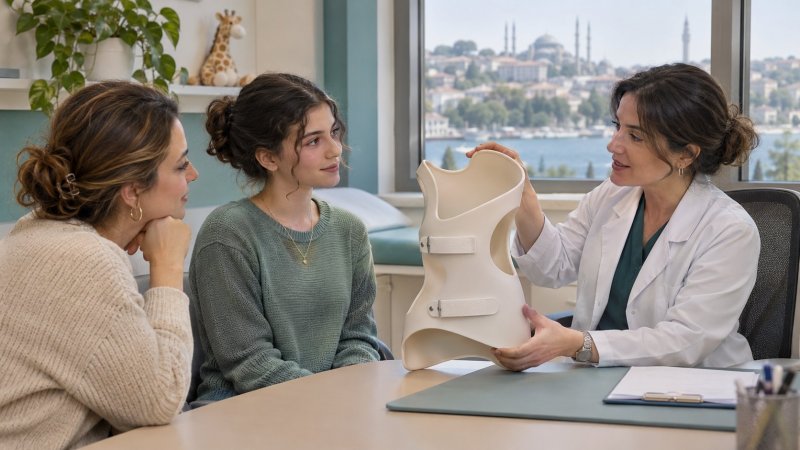
Ask the orthotist to show you how to put the brace on, how to check the fit and whom to contact about skin soreness or disturbed sleep. If school or heat makes the prescribed wear schedule difficult, bring that up early. The care team can check pressure points and discuss practical adaptations. A follow-up visit should cover how the young person is coping as well as what the film shows. Physiotherapy can support strength, movement and confidence. Its role depends on the type and severity of the curve. [5, 6]
Adults may benefit from a tailored exercise programme, pacing activities and a review of pain relief with their own clinician. Selected injections may offer symptom relief when a particular nerve is irritated. These options serve different goals from deformity correction. For example, being able to walk to a nearby shop with less leg pain may matter more to a patient than a change in the shape seen on an X-ray. Agree an outcome to monitor and a point at which to revisit the plan. [9, 12]
When to discuss fusion and how the surgeon chooses levels
For an adolescent with idiopathic scoliosis, a curve around 45 to 50 degrees or more commonly leads to a surgical discussion, especially if progression continues. There is no universal operating date attached to that number. A specialist considers growth, curve pattern, documented change, balance and the young person's preferences. Ask what the team thinks will happen over the next year with observation and what it expects over a longer period. Those are different predictions with different degrees of certainty. [5, 7, 11]
Posterior spinal fusion is a familiar operation for a progressive adolescent curve. Through an approach from the back, the surgeon anchors screws to selected vertebrae and connects them with contoured rods. Bone graft helps the selected segments grow together over time. The implants hold the intended alignment while that healing occurs. The goal includes balance and long-term control. A perfectly straight radiograph is rarely the most meaningful measure of whether a person can move, dress, sit and live comfortably afterwards. [7, 11]
The upper and lower ends of the fusion deserve a specific conversation. Leaving more mobile lumbar levels can matter for bending in daily life. A fusion that stops too soon can leave a curve inadequately balanced. Ask the surgeon to point out the proposed end vertebrae on your own images, describe which parts should remain mobile and explain any reasonable alternative. A friend's shorter fusion may have addressed a different pattern. The number of screws alone cannot tell you how much motion you will retain. [7, 11]
For a much younger child, an early long fusion can sacrifice growth in the treated part of the spine and chest. Selected children may be offered growing rods or another growth-friendly system to control the curve while allowing lengthening. The family should understand how lengthening works with that device, the need for regular surveillance and the possibility of unplanned operations for implant or wound problems. A treatment involving several years of visits demands a practical cross-border follow-up arrangement before the first procedure. [3, 5]
Vertebral body tethering is a selective alternative for some growing patients with idiopathic scoliosis. A flexible cord attached to screws on the front or side of the vertebral bodies uses remaining growth to influence correction. Too little growth can limit correction and further growth can sometimes lead to overcorrection. Tether failure or subsequent fusion is possible. The US humanitarian device authorization has defined selection criteria. Local availability, regulatory arrangements and the team's experience in Turkey require separate confirmation. Ask why tethering would suit this particular curve better than bracing or fusion. [7, 8]
In an adult whose dominant problem is nerve compression, the surgeon may consider targeted decompression. A longer fusion may enter the discussion when deformity, poor balance or instability contributes substantially to symptoms. More extensive surgery can bring a greater burden of recovery and complications. In a five-year study of selected adults with symptomatic lumbar scoliosis, those treated surgically had better average patient-reported outcomes, and serious treatment-related events occurred. The results cannot determine which choice is best for an individual with different symptoms, bone quality or medical conditions. [9, 10, 12]
Understanding the risks and preparing for hospital
Ask the team to explain the important risks in terms of the proposed operation. Bleeding, infection, injury to nerves or spinal cord, complications of anaesthesia, implant problems and failure of a fusion to heal are among the issues to discuss. A new operation may be needed. Medical history, curve rigidity, number of levels, previous surgery and the demands of recovery all matter. Monitoring nerve signals during surgery can alert the team to a change. It cannot eliminate every neurological risk. [7, 11, 12, 13]
Make a medication list that includes over-the-counter products, supplements and allergies. Discuss blood-thinning medication with both the prescriber and the surgical team. Ask for written instructions specific to you. In some patients the anaesthetist also needs a respiratory assessment, a nutrition review, blood tests or information from a cardiologist. In an adult with fragile bones, a bone-health assessment can influence the plan. For someone dependent on assisted coughing or specialised seating, bring the relevant care plan well before admission. [11, 12, 15]
The first days after surgery usually involve regular neurological checks, pain and nausea management and help getting out of bed when appropriate. The physiotherapist may practise walking and stairs, or safe transfers for a wheelchair user. Discharge depends on clinical progress and a safe destination. A hotel staircase, a long drive from the airport or a parent who cannot lift a child can change the practical plan. Tell the ward team about those details while there is time to arrange help. [11, 12]
Recovery in Istanbul and after returning home
Ask for a discharge summary in a language your local clinician can use, an operation note or summary of the treated levels, an implant record when applicable and copies of postoperative images. Confirm who will check the wound, which medications to take and who can answer questions after hours. Being well enough to leave hospital and being ready for a long flight are separate decisions. The surgical team can assess travel readiness and blood-clot precautions against your circumstances and journey. [11, 12]
A return to education or desk work may begin well before clearance for lifting, contact sports or physically demanding work. Build the plan around actual tasks. A child might manage a lesson at home before tolerating a crowded commute with a backpack. An adult who can walk comfortably may still struggle to sit through an entire shift. Ask what changes in pain or function should lead to an earlier review, and what evidence the team needs before increasing activity. [7, 11, 12]
Contact the treating team promptly about increasing wound redness, discharge, fever or pain that is worsening instead of settling. New weakness, difficulty breathing, chest pain or loss of bladder or bowel control can require urgent local assessment. Do not wait for an international reply when serious symptoms appear. Keep the emergency plan with a caregiver and make sure they know the local hospital you would use. Planned follow-up remains important even when the early recovery is going well. [11, 12, 14]
What to send for an Istanbul evaluation
Send dated full-length images and reports, older comparison studies, previous operation notes, a brace prescription and records of how the curve changed during treatment. Original DICOM files allow the team to review the studies more fully than screenshots. Add a short account of symptoms, walking or sitting tolerance, school or work needs and what change matters most. For a child, include recent growth information. For an adult, list relevant conditions, prior spinal surgery and any known osteoporosis or fragility fractures.
Ask Recmed Medical Travel how to submit your records through its designated channel and what parts of the initial evaluation can be completed remotely. A written quotation should specify the proposed procedure, hospital care, implants, investigations and follow-up, and identify services billed separately. Ask how a revised plan after examination, a longer admission, accommodation, interpretation and a change to the return journey would be handled. Those questions are useful even when two headline quotations look similar. Contact Recmed about a scoliosis evaluation.
Questions families ask before deciding
If the curve is painless, why would anyone recommend surgery?
In growing adolescents the concern may be continued progression and the likely future behaviour of a large curve. Pain is one part of the picture. Ask to see the sequence of films, the estimate of remaining growth, the goals of intervention and a realistic observation plan. A reasoned recommendation should make sense to the young person as well as to the adults in the room. [2, 5, 7]
Will the rods come out once the bones heal?
Rods used for a definitive fusion are generally intended to stay in place. Symptoms such as a wound problem or pain near an implant need evaluation to establish their cause. Routine removal is a different question from revision for a specific problem. Growing systems in younger children have their own planned course. Ask which type of implant your operative record describes and why future procedures might be considered. [3, 7, 13]
How should I compare two different surgical opinions?
Ask each surgeon to describe the diagnosis, the objective, the levels proposed and the likely course with observation or nonsurgical care. Then compare how they would monitor recovery and manage a complication after you return home. If one offers a newer technique, ask about follow-up duration and the possibility of further surgery. A difference between recommendations is a good reason to clarify which assumptions about growth, balance or symptoms differ. [7, 8, 12]
Where should we start if the diagnosis is still uncertain?
Start with the reason the curve came to attention and obtain the original study rather than arranging every possible scan. A local clinical examination can establish whether urgent attention is needed and identify which specialist is appropriate. For patients comparing several types of back or nerve surgery, Recmed's overview explains the wider evaluation and travel process. Read the guide to spine surgery in Turkey.
Which follow-up questions should be settled before we travel?
Write down the name of the team that will assess the wound and who will receive the first set of follow-up films. Ask whether the team needs images taken standing or sitting, and whether the clinician at home should compare them with the immediate postoperative films. If a young person normally uses a wheelchair, discuss how long they can sit during the journey and whether the seating system will still fit after correction. For a student, ask for a letter explaining temporary adjustments such as shorter days, a second set of books or extra time between classrooms. These arrangements may matter more to a child's first weeks back at school than the exact date they return. A follow-up appointment is easier for a family to keep when they know its purpose and can share the records beforehand. [11, 15, 16]