If a surgeon has offered a keyhole operation for sciatica or difficulty walking, ask them to show you exactly what they plan to release. A disc fragment pressing on one nerve may be accessible through a narrow channel. Several tight areas on both sides of the spine, an unstable joint or a deformity affecting how you stand present different problems. The aim is to choose an approach that gives the surgeon enough room to do the necessary work safely. The length of the skin incision tells you relatively little about that. 1, 2
This guide is for people considering minimally invasive spine surgery in Turkey, including those comparing an endoscopic opinion with a recommendation for conventional surgery at home. It focuses on common lumbar procedures. Evidence about releasing a nerve in the lower back cannot simply be applied to the cervical spinal cord, a fracture or major scoliosis surgery. Before making travel arrangements, establish which symptom the proposed procedure should improve, which alternatives remain reasonable and what care you would need after going home. 1, 2, 5, 6
What the different names mean
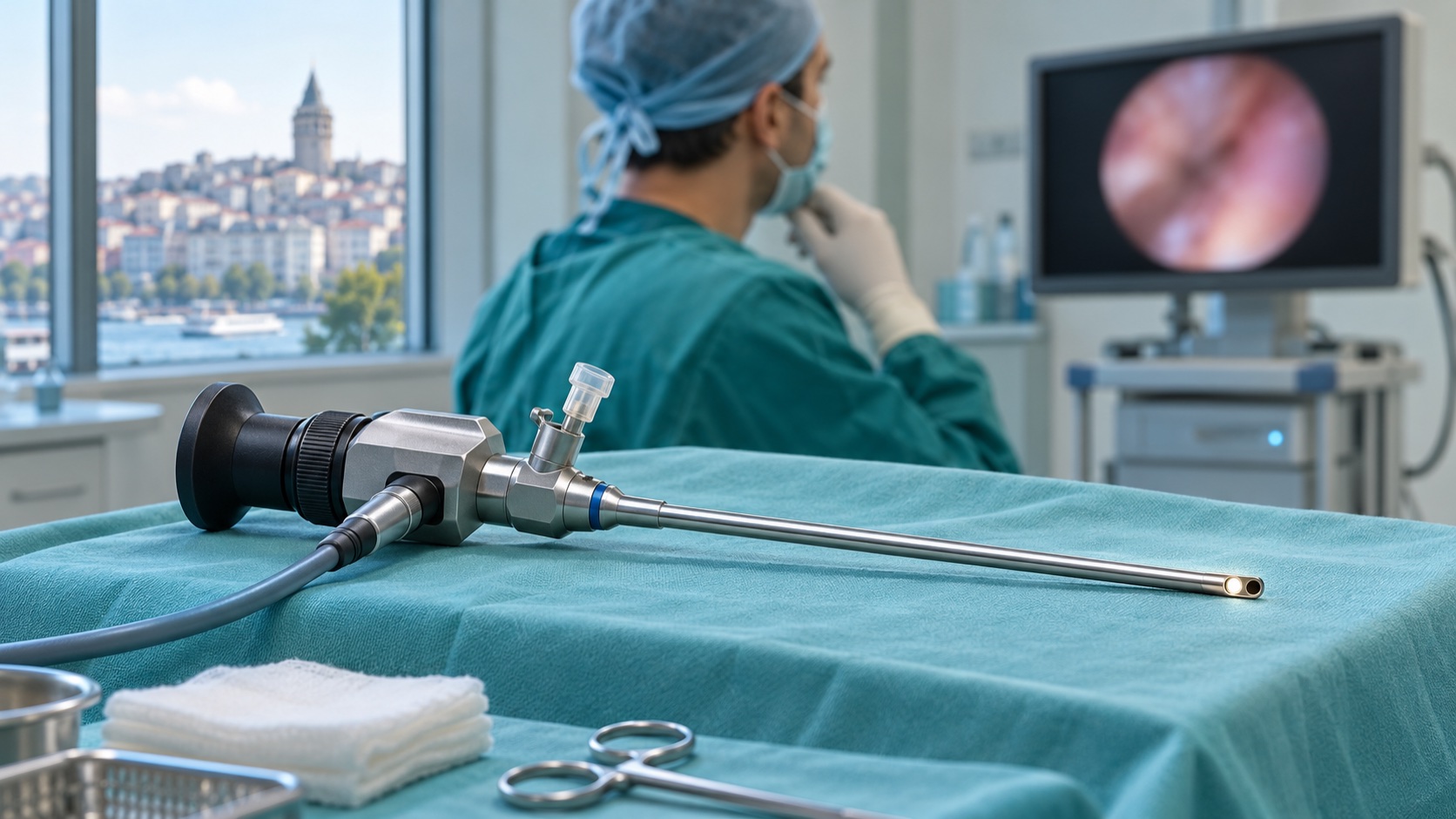
Minimally invasive is an umbrella term. Some operations use a tube placed between muscle fibres and a microscope above the wound. Others use an endoscope, a slender instrument containing a camera and a light that gives the surgeon a close view on a screen. A fixation procedure may use screws inserted through several short incisions. These approaches can reduce the amount of muscle that needs to be moved aside, but the work on the disc, nerve or bone underneath can still be substantial. 1, 2
The word microscopic describes magnification. A surgeon can use a microscope during a short conventional microdiscectomy, a tubular operation or a wider decompression. The word percutaneous describes passage through the skin and says little about the aim of treatment. Ask for a name that includes the action, level and side, such as removal of a disc fragment compressing a particular lumbar nerve. That wording lets another clinician compare two proposals even if the hospitals use different equipment or marketing terms. 1, 2, 5
In a full-endoscopic procedure the optics travel close to the target inside the body. Instruments may pass along a working channel in the endoscope. In a biportal procedure the viewing equipment and instruments go through separate small openings. Neither arrangement determines the extent of treatment by itself. A one-level endoscopic discectomy, a decompression for stenosis and a fusion with screws each involve different steps, risks and healing times. Ask which of those operations is actually being proposed. 1, 2, 5, 6
Find the source of your symptoms first
A lumbar nerve root travels from the spinal canal towards an opening between adjacent vertebrae. A disc fragment can irritate or compress it along the way. Some people have pain travelling from the buttock into a particular part of the leg or foot. Others report pins and needles, reduced feeling or weakness. Describe where the symptoms start, how far they travel and what you can no longer do. A new difficulty lifting the front of the foot means something different from pain after sitting for a long time. 2, 7, 8
Stenosis means narrowing. The space affected may be the central canal, the side passage where a nerve travels or the opening through which it exits. Some people with lumbar stenosis develop leg heaviness or pain on standing and walking that settles when they sit or lean forward. The surgeon needs to know if one or both legs limit the walk, how far you get and whether weakness persists at rest. Hip disease and poor blood supply can also limit walking and may require a different assessment. 2, 6, 8
An MRI report can list changes at several levels. The most dramatic phrase in the report does not necessarily explain the symptoms you want treated. Ask the specialist to show the nerve and the point of compression in more than one view and explain how these findings fit the examination. If the chief complaint is widespread back pain without a convincing surgical target, a smaller incision cannot solve that uncertainty. A useful evaluation may end with rehabilitation, another investigation or observation. 1, 2, 7
Which investigations can change the choice?
An examination checks the pattern of weakness, sensation, reflexes and walking. It helps distinguish pain-limited effort from loss of power and provides a baseline for comparison after treatment. Tell the specialist when a deficit began and whether it is progressing. A family member's observation that your foot catches on a step can be more informative than a general pain score. For a remote consultation, bring any recent examination findings. A video review may need to be followed by an examination in person. 2, 7, 8
MRI usually provides the most useful map of discs, nerve roots and soft tissues when planning decompression. The surgeon may need the complete image series to see whether a fragment has migrated or pressure extends beyond one narrow point. CT can clarify hard bone, a calcified component or earlier surgical changes when that would affect the route. Standing radiographs can help assess alignment or a slip under load. Additional imaging makes sense when the answer could alter treatment. Ask before repeating a study solely because you are travelling. 1, 2, 7
If previous surgery involved the same level, include the operation note. A patient may remember having a disc removed while the report also describes removal of part of a joint, repair of a tear or instrumentation. Scar tissue and altered landmarks may make another passage preferable or increase the chance of needing a wider view. If current symptoms affect the opposite leg, say so explicitly. The old diagnosis is a starting point for assessing a new problem. 1, 2
Who might reasonably consider a limited approach?
One common example is a person with persistent disabling leg pain, an examination that fits one nerve root and a corresponding disc herniation on MRI. When appropriate nonsurgical care has not restored acceptable function, both a microdiscectomy and a suitable endoscopic removal may be worth discussing. The surgeon considers the location and movement of the fragment, the bony opening available and whether the entire area can be reached. A recommendation for surgery still requires a separate discussion about expected benefit, alternatives and timing. 3, 4, 5, 7 Microdiscectomy and endoscopy for lumbar disc herniation.
For stenosis, a limited decompression may be considered when the troublesome narrowing can be addressed adequately through that corridor and the segment can remain sufficiently stable. The operation may involve removing some bone and thickened ligament. If both legs are affected, ask how the opposite side will be released. In selected anatomy the surgeon can work across from one side. In other cases direct access to both sides or multiple levels may be more appropriate. Ask how the doctor will recognise adequate decompression. 1, 2, 6 Decompression for lumbar spinal stenosis.
A different question arises if the spine is unstable or a major correction in alignment is needed. Releasing one nerve does not by itself correct a collapsing deformity. Equally, a finding of wear does not automatically justify fusion. If the proposal includes percutaneous screws or a cage, ask what mechanical problem they are intended to solve and why nerve relief alone would be insufficient. The bone still needs time to unite even if the screws are inserted through small openings. 1, 2 How lumbar fusion approaches differ.
Nonsurgical choices and situations that need urgent attention
With stable nerve function, some people improve enough with time, activity adjusted to symptoms and an individual exercise or physiotherapy plan. A clinician can review pain treatment against your other conditions and medicines. For some people with acute severe sciatica an epidural injection is an option to discuss. Its purpose is to reduce symptoms in selected circumstances. It neither removes a large compressive fragment nor restores stability to a mobile segment. Agree how progress will be judged and which changes should trigger another examination. 7, 8
Choose a useful benchmark while you wait. Can you sleep through more of the night, walk to a nearby shop or return to a lighter work shift? Improving function can change the balance even when the scan looks the same. On the other hand, increasing loss of power needs prompt medical assessment. New difficulty emptying the bladder, loss of bladder or bowel control, numbness around the genitals or saddle region, or rapidly worsening weakness requires emergency assessment locally. Do not wait for a travel date or overseas video appointment. 7, 9
How the surgeon reaches the target
In a transforaminal endoscopic discectomy the route approaches from the side through the region where a nerve exits the spine. In suitable cases this gives a path to disc material without approaching the central canal directly from behind. The height of the pelvic rim, the shape of the opening and the direction in which the fragment has moved can affect access. Ask the surgeon to explain the position of the exiting nerve and what would happen if the fragment could not be reached from that angle. 2, 3, 5
An interlaminar approach reaches the target from behind through the interval between adjacent arches of bone. It may offer a more direct view of some disc fragments or areas of narrowing. Bone or ligament may need to be removed to make space and protect the nerve. The interlaminar opening differs between levels and individuals. A proposal for this route is most informative when the surgeon can show its relationship to the target on your own images and explain the alternative access. 2, 4
Tubular microscopic decompression uses a small working corridor and magnification but places the surgeon's viewing equipment outside the body. Some surgeons prefer the instruments and orientation this provides for particular patterns of pressure. A conventional approach may offer more freedom to identify landmarks, work around scar tissue, control bleeding or repair the membrane around the nerves. Ask for the advantages and disadvantages of each feasible route for your anatomy, including what a larger exposure would allow the team to do more reliably. 1, 2, 6
What comparative research actually tells patients
A Dutch randomised trial compared transforaminal endoscopic removal with conventional microdiscectomy for sciatica caused by lumbar disc herniation. It enrolled 613 adults aged 18 to 70 with at least six weeks of radiating leg pain, including a planned group treated while surgeons gained experience. At one year the endoscopic procedure met the study's criterion for being no worse for leg pain. This supports an alternative for appropriately selected patients. It does not establish that all disc fragments, patients with isolated back pain or people with stenosis benefit in the same way. 5
Lumbar stenosis has its own evidence. A 2026 review of randomised trials comparing decompression without fusion found that an apparent advantage for disability at one year depended heavily on one study with reporting concerns. The evidence did not establish a reliable lasting advantage for pain, disability or safety. This matters when a hospital advertises faster early mobilisation as proof of a better long-term outcome. Ask about walking ability, function, complications and further operations over a period relevant to you, alongside initial wound discomfort and length of stay. 6
For endoscopic lumbar discectomy, the UK's NICE guidance emphasises specific training, mentoring, regular practice, consent and clinical oversight. Experience with one endoscopic procedure is not the same as experience with every spinal level or a previously operated spine. Useful questions concern how often the surgeon treats your particular problem, what outcomes the team tracks and how a complication can be managed. A small published series or a testimonial cannot provide an individual probability of recovery. 3, 4, 5, 6
Benefits, limitations and the possibility of changing the plan
Less soft-tissue exposure may mean less early wound pain or a shorter stay for some operations. These are meaningful benefits if you can safely mobilise and have adequate support. They do not ensure that numbness will resolve, a weakened muscle will regain normal strength or a sedentary worker and a heavy manual worker will recover at the same pace. Clarify which symptom has the best chance of improving, especially if your leg symptoms began recently but your low back has hurt for years. 1, 2, 5, 8
Potential complications include infection, bleeding, a tear in the covering around the nerves with leakage of spinal fluid, nerve injury, persistent symptoms and recurrence. Disc material can herniate again even after a technically successful removal. An incompletely released nerve may require reassessment or further surgery. Less common events can still be important to you if they affect walking, continence or independence. Ask about both the risk of your proposed procedure and the likely course if you continue with nonsurgical care. 1, 2, 5, 6, 8
Sometimes the surgeon discovers that visibility is poor, the anatomy differs from expectations or the target cannot safely be released through the intended route. Converting to wider access may then be the safest way to finish, repair a tear or control bleeding. Discuss this possibility before consent. Clarify which changes are foreseeable, which would require a later discussion and how you or your accompanying person would be told what actually occurred. A plan for conversion is part of preparing for a real operation. 1, 2
Preparation and the first days after surgery
Bring a current medication list, allergies, previous anaesthetic problems and details of anticoagulants, diabetes, smoking and other conditions relevant to surgery. Ask the treating team for individual instructions about medicines and fasting. Never stop a prescribed anticoagulant on the strength of general website advice. Talk about the anaesthetic planned for your particular operation. An awake or sedated procedure is an option for some techniques and patients, while others need a general anaesthetic. Your ability to go home the same day depends on much more than that choice. 1, 2, 8
Before discharge the team considers pain control, leg strength and sensation, ability to pass urine and whether you can move safely. If you will have stairs, a low bed or a long journey to accommodation, mention these arrangements. Ask someone to go through wound care and the plan for any new symptom while you can still ask questions in your preferred language. Write down which symptoms should prompt contacting the surgical team that day and which require the nearest emergency department. 8, 9
Recovery has several timelines. Incisional soreness may settle before nerve irritation, tingling or weakness. A short daily walk may be achievable before commuting or standing through a work shift. If fusion was part of the surgery, bone healing and loading restrictions can extend much longer. Ask for personal milestones for walking, lifting, driving and returning to work. A professional driver who takes sedating medicine, for example, has different safety requirements from someone who can work from home in short sessions. 1, 2, 8
How to compare two reasonable recommendations
Suppose your main difficulty is standing long enough to cook. One surgeon proposes endoscopic removal of a small disc fragment on the right. Another proposes decompressing both sides for stenosis. Before weighing which operation sounds easier, check whether they are addressing the same problem. Does standing produce pain down the right leg, tiredness in both legs, or pain mainly across the back? Has either clinician watched you walk and checked leg strength? Bring both written proposals to the review and ask the specialist to identify the findings that favour one interpretation. 2, 6, 7
Now suppose both surgeons agree that one nerve needs releasing and disagree only about the route. Ask each what they expect you could do six weeks later, which movements or work tasks might still be difficult and how they would investigate persistent symptoms. Compare the follow-up arrangements as carefully as the early recovery claims. Someone who lives several hours from a spine unit may reasonably put more weight on a clear handover and access to assessment after discharge. The choice becomes clearer when you compare the same diagnosis, outcome and follow-up interval. 1, 2, 8
Arranging an assessment and follow-up in Istanbul
Send a concise history, the complete MRI or CT in its original DICOM format, dated reports, any prior operation notes and a list of treatments already tried. Note which leg is affected and recent changes in walking or strength. Contact Recmed to agree how to transfer records and what language support or consultation arrangements are available. A coordinator can help organise the review. The clinical team determines candidacy and may revise an initial opinion after examining you in person. Plan a spine consultation in Turkey. Request an assessment in Istanbul.
For a written quotation, ask which levels and procedure it covers, whether an implant is planned, what hospital services and follow-up are included and what would change if a different approach were needed. Confirm the plan for remaining near the hospital and ask the surgical team when flying is medically appropriate. Keep copies of your operative report, discharge medicines, wound instructions and any imaging on departure. Arrange who can examine you locally if symptoms change after your return. A remote update is useful for routine progress. Sudden chest pain, shortness of breath or new bladder and saddle symptoms need emergency care where you are. 8, 9
Questions to take to your consultation
Could the operation be done through a smaller incision than the one I was offered?
It may be possible. Ask what the proposed smaller route can reach, whether it would release the whole nerve and how the surgeon would protect structures immediately beside it. Ask the first surgeon why a wider exposure was recommended. A disagreement about how to reach a well-defined target is quite different from disagreement about whether the target explains your symptoms. The second question should be settled first. 1, 2, 7
Does endoscopy mean a laser is necessary?
An endoscope supplies light and a view. The surgeon chooses instruments according to what needs removing, such as soft disc material or a bony narrowing. A named energy device does not establish suitability or guarantee a better outcome. Ask which tissues will be treated and what evidence supports the complete procedure for your diagnosis. Evidence for endoscopic disc removal should not be assumed to apply to every treatment described as laser spine surgery. 1, 2, 3, 4
What should I do if leg pain returns after an initial improvement?
Note when it returned, whether it affects the same area and whether weakness, wound changes or bladder symptoms accompany it. Contact the treating team for assessment. Examination and, when needed, imaging help distinguish expected nerve irritation from recurrent disc material, residual compression or another cause. Ask in advance who will review you at home and which records that clinician will need. An emergency change warrants local emergency care immediately. 5, 8, 9