If pain shoots from your buttock down one leg, the first decision is whether a lumbar disc is irritating a nerve and whether that nerve needs urgent treatment. Choosing a surgical instrument comes later. Many people improve without an operation. Others have leg pain that continues to disrupt sleep, work or walking despite appropriate care. A smaller group develops weakness or changes in bladder or bowel function that need urgent assessment close to home. This guide explains how to tell those situations apart and what a surgical opinion in Istanbul can realistically answer. 1, 2, 3, 4
What has happened to the disc?
A lumbar disc sits between two bones in the lower back. Its tough outer ring surrounds a softer centre. When part of the softer material pushes through a weak or torn area, it can irritate or compress a nearby nerve root. Both physical pressure and inflammation may contribute to symptoms. A herniation differs from a general loss of disc height or a broad bulge. Those changes occur in people with and without pain. Finding one on a scan cannot establish by itself what is causing your symptoms. 1, 2
A radiologist may describe a protrusion, extrusion or sequestration. These words describe the shape of the material and whether a fragment remains connected to its disc. A fragment can migrate slightly above or below its original level. Some extruded fragments shrink as the body gradually clears material. An alarming description does not automatically mean you need an operation. Equally, a small fragment in a tight exit opening may cause disabling symptoms. Its position in relation to a nerve, your strength and your progress matter more than a measurement in millimetres alone. 1, 4, 11
Levels are named for the neighbouring bones. L4–L5 and L5–S1 are common sites. A fragment near the middle of the canal can affect a nerve passing down towards the next opening. A fragment farther to the side can affect the nerve leaving at that level. This is why two people with identical level numbers can have pain in different parts of the leg and may be offered different surgical approaches. Ask your surgeon to point out the affected nerve, the side and the route to the fragment on your own images. 1, 8, 9
Pain down the leg, weakness and changes that need emergency care
Sciatica describes pain travelling along the leg. It can feel burning, electric, deep or sharp. Some people have more pain below the knee than in the back. Coughing, sitting or getting into the car may provoke it. Numbness or tingling may persist between painful episodes. In the clinic, describe where the symptoms begin, where they reach and what you have stopped doing. A mark on a simple outline of the leg is often more helpful than trying to remember the name of a nerve. 1, 11
Weakness changes the conversation. A foot that slaps the floor, catches on doorsteps or will no longer push off normally deserves prompt assessment. Pain can prevent someone from exerting full effort without true loss of nerve function. An examination helps distinguish this from a muscle that is actually getting weaker. Tell the clinician the last day you could climb stairs normally or control the pedals safely. A rapid change matters even if the pain has recently eased. A major or worsening loss of strength needs urgent local evaluation. 1, 4
Seek emergency care immediately for new difficulty starting urination, loss of the usual feeling of urine passing, numbness around the genitals or anus, or a new loss of bowel control with back or leg symptoms. These can be early features of cauda equina syndrome, in which several nerve roots at the bottom of the spinal canal are compressed. Do not wait for complete incontinence, a reply from a clinic abroad or a flight to Turkey. New severe symptoms after significant trauma, or back pain with fever and systemic illness, also need timely local assessment. 1, 3
How the examination and MRI establish a diagnosis
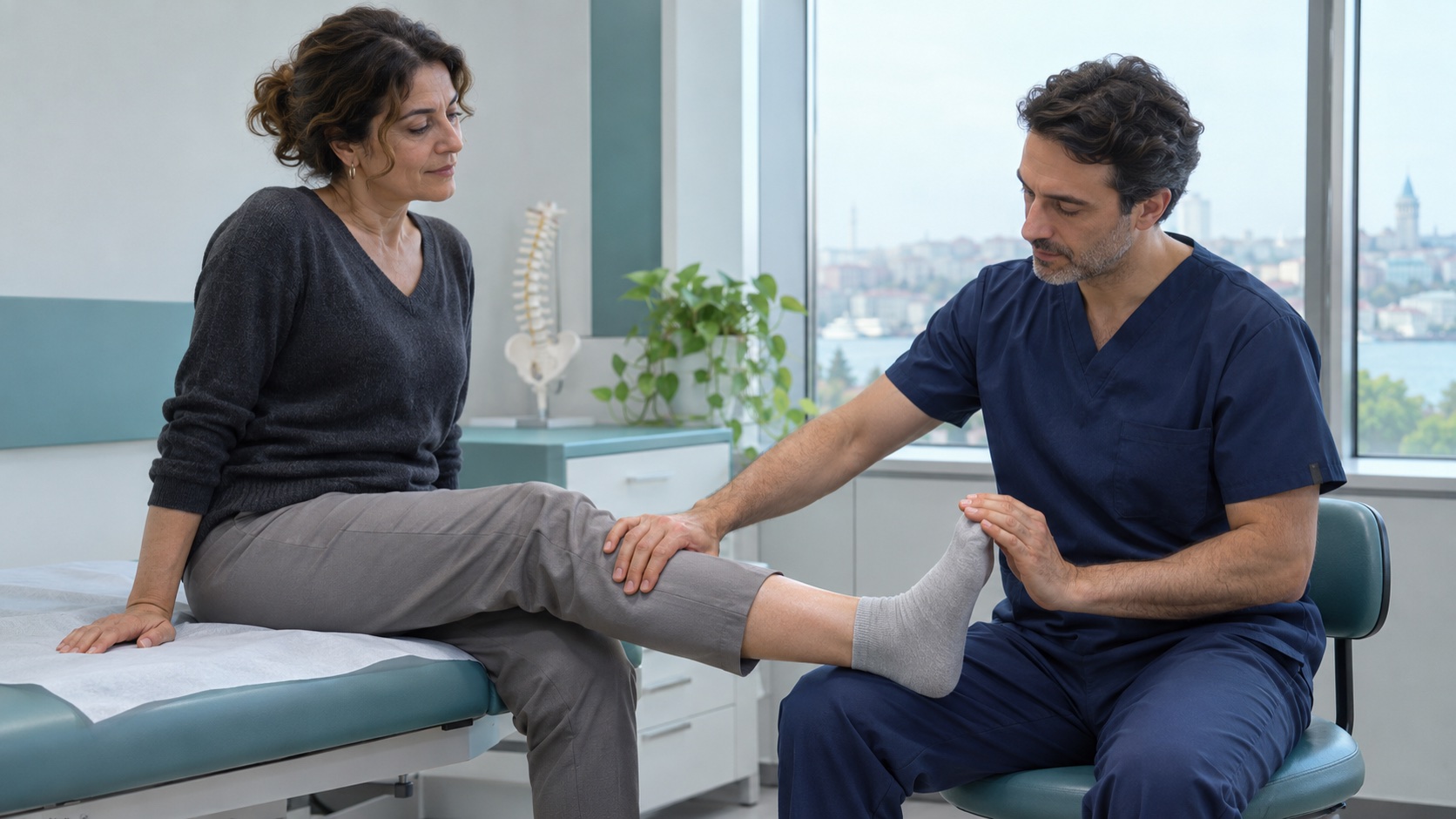
A clinician compares the two legs, checks muscle groups and reflexes, and tests whether sensation changes in a pattern that fits a nerve root. Raising a straight leg may reproduce familiar radiating pain. Simply feeling tension in the hamstrings is a different response. The clinician may also examine your hips and circulation or consider a peripheral nerve injury. A foot drop from a nerve trapped near the knee, for example, needs a different plan from a foot drop due to a disc fragment. 1, 2
MRI shows soft tissue, discs and nerves. In uncomplicated early sciatica, immediate imaging often does not alter care. It becomes more important if weakness progresses, there are features of a serious cause, or persistent symptoms make an intervention a realistic option. A scan is useful when the proposed treatment depends on its result. The clinical side should match the relevant finding. Ask for an explanation if your main pain is on the left but the leading abnormality in the written report is on the right. 1, 2, 3
A plain X-ray can show alignment and bone changes but cannot directly show the soft disc fragment pressing on a nerve. CT can be useful in selected situations, particularly for bony anatomy or when MRI is unsuitable. Electrical nerve tests are sometimes helpful if the examination suggests another nerve problem or imaging does not explain weakness. None of these tests needs to be added routinely just because a patient will be travelling. Ask which uncertainty the test will resolve and whether the answer could change the operation or avoid one. 1, 2
Some patients have both a herniation and age-related narrowing at several levels. Leg pain from one irritated nerve may persist even when sitting. By contrast, spinal stenosis often limits standing and walking, with relief when sitting or bending forward. These patterns can overlap. When a report lists both conditions, ask which problem accounts for the symptom that most limits your day. A targeted fragment removal and a wider decompression address different anatomical problems. How lumbar stenosis affects standing and walking. 1, 2
What a reasonable trial of nonsurgical care involves
When there are no emergency features or important progressive deficits, early care usually aims to keep you moving within tolerance and make daily life manageable while the nerve settles. Discuss a tolerable amount of walking, short changes of position at work and an achievable sleep arrangement. A physiotherapist can help adapt activity to symptoms and rebuild confidence. There is no single exercise that pushes all herniated discs back into place. If a programme is not tolerable, seek a review of the plan and report new weakness promptly. 1, 2, 11
Pain medicines need an individual review. Some anti-inflammatory medicines can cause gastrointestinal bleeding or affect kidney or heart health. The choice is different for a person taking blood thinners, someone with a history of ulcers or someone with kidney disease. NICE advises against routinely offering certain medicines for sciatica, including gabapentinoids, oral corticosteroids and benzodiazepines, because the balance of benefit and harm is unfavourable. Ask for a medication review if sleep and basic movement remain difficult. Do not abruptly discontinue prescribed medicines without clinical advice. 2
An epidural injection of local anaesthetic and steroid may be considered for selected people with acute, severe sciatica. Its purpose is to reduce symptoms and sometimes allow more activity while the nerve settles. It does not remove the fragment. Weigh possible short-term relief against procedure risks and your own medical circumstances. An injection should not delay evaluation of worsening motor function or suspected cauda equina compression. If one is suggested, ask what the team hopes it will achieve and what the next step is if it gives little relief. 2, 3, 11
When earlier surgery and waiting are both reasonable choices
For stable symptoms, the argument for an operation becomes stronger when persistent leg pain or functional loss remains unacceptable, treatment without surgery has not provided enough improvement, and the examination matches a treatable fragment on imaging. Define what unacceptable means for you. It might be repeated lost sleep, inability to walk to a bus stop or inability to perform essential work despite adjustments. Record whether these limitations are improving, unchanged or getting worse. That pattern matters alongside the number of weeks since onset. 2, 4
In a Dutch trial, people with severe sciatica lasting six to twelve weeks were assigned either early surgery or a longer trial of conservative care with surgery available if needed. Those assigned early surgery obtained faster relief of leg pain. Outcomes drew closer over time, and some people assigned conservative care later had surgery. The choice in that study was therefore between two strategies with different periods of symptoms and different chances of eventually needing an operation. Its results do not justify making someone with an emergency wait. 5
A Canadian trial asked a different question. Patients had sciatica lasting four to twelve months and imaging showing a herniated lower lumbar disc. The group assigned microdiscectomy had less leg pain at six months than the group assigned further nonsurgical management. The finding is relevant for someone still markedly disabled after a sustained period of care. It does not tell a newly symptomatic person that surgery is certain to be necessary. Ask which group resembles you in the duration of symptoms, examination and activity you need to regain. 6
Microdiscectomy and endoscopic discectomy compared
In microdiscectomy, the surgeon reaches the disc from the back using magnification and a limited opening over the affected level. When necessary, a small amount of bone or ligament is removed to expose the nerve safely. The goal is to clear the material responsible for the pressure while preserving as much normal structure as practical. The entire disc is generally not removed or replaced. A clinician discussing this procedure should be able to explain what will be taken out and what will remain at the end. 1, 4
Endoscopic discectomy uses a camera and fine instruments through a working channel. A transforaminal route approaches through or near the opening through which a nerve leaves the spine. An interlaminar route uses the natural space between the bony arches from behind. The two routes provide different views. At L5–S1, the shape of the pelvis can limit a side approach, while the interlaminar window may provide suitable access to certain central or paracentral fragments. Location, migration and the surgeon's experience influence which route is practicable. 8, 9
The important comparison is whether the surgeon can see and free the correct nerve through the proposed route. A very small incision is of limited value if a migrated fragment is difficult to reach, if additional bony narrowing needs treatment or if the surgeon must leave important compression behind. An endoscopic route can be appropriate in experienced hands, and a conventional microdiscectomy can already use a small exposure. Ask what would lead the team to enlarge or change the approach and how that decision would be discussed before surgery. 4, 8, 9
A multicentre Dutch trial compared transforaminal endoscopic discectomy with open microdiscectomy in adults with at least six weeks of radiating leg pain from disc herniation. At twelve months the endoscopic method met the study's prespecified test for being no worse for leg pain. Some outcomes favoured endoscopy, but relatively small differences between groups do not predict a particular person's recovery. The trial addressed a specific operation in selected patients. It cannot establish that every endoscopic technique is preferable for every fragment or that surgeon experience is unimportant. 7
Both techniques aim chiefly to relieve nerve-related leg pain. Aches centred in the lower back can come from several structures and may persist after successful decompression. Numbness may recover slowly, and established weakness may be incomplete in its recovery even if pain improves promptly. Fusion fixes two or more vertebrae together and addresses a different mechanical problem. It is not routinely required with first-time removal of an isolated disc herniation. If fusion is proposed, ask what separate evidence of instability or other relevant pathology makes it necessary. 1, 4
Risks, recurrence and what happens in hospital
Potential complications include infection, bleeding, a tear in the covering of the nerves with leakage of spinal fluid, injury to a nerve, persistent symptoms or further surgery. An endoscopic passage near a nerve can also cause irritation or an altered burning sensation. A remaining fragment is a different problem from a fresh herniation after a period of recovery. Ask the surgeon to describe risks relevant to your level, previous operations and planned route, and how the team investigates persistent or returning symptoms. Report worsening weakness promptly, whatever the technique used. 4, 7, 8, 9
Before admission, provide a list of medicines and allergies and tell the team about diabetes, previous spine surgery, clotting problems and any past reaction to anaesthesia. Obtain specific written instructions for blood thinners from the clinicians responsible for them. Confirm the level and side of surgery alongside the team and describe your usual leg strength before treatment. Ask whether you can mobilise independently after the procedure or may need short-term assistance. Same-day discharge is possible for selected patients, but pain control, safe mobility and neurological findings influence the actual stay. 1, 10
After the operation the team checks movement and sensation, comfort and your ability to mobilise and pass urine. Some soreness around the incision is expected. Make sure you understand the wound instructions and which symptoms need a call or emergency review. New saddle numbness, loss of bladder function or rapidly worsening weakness requires urgent assessment. Seek prompt advice for fever, increasing wound redness, new drainage or severe pain that is getting worse. Ask where to seek emergency care if the operating team is in another country. 3, 10
Returning to activity and arranging care in Istanbul
Early walking as advised by the team can help restore confidence. Start with distances you can manage safely, change position and build activities in a way you can sustain the next day. A tolerable first outing does not mean you are ready to carry luggage upstairs. Ask for written guidance about lifting, driving, work and any individual restrictions. Return to a desk with flexible breaks can differ substantially from returning to warehouse shifts or professional driving. Describe both your duties and the journey to and from work. 1, 10
If leg pain returns, note whether you had a period of clear improvement, whether it follows the same side and path, and whether strength or bladder function has changed. New pain does not establish recurrent herniation on its own. Recovery, ongoing irritation, new compression or a different source can all require consideration. Your team can decide whether examination or new imaging would alter the plan. A second operation is an individual decision; the fact that a previous technique worked or failed does not select the next treatment automatically. 1, 4, 10
For an opinion in Istanbul, prepare your full lumbar MRI in DICOM format, the radiology report and available previous images. Add a brief history of symptoms, the painful side, how far pain travels, any documented strength change and what treatment you have already tried. Include the date, level and effect of injections and any previous operative reports. A specialist reviewing records can identify whether the proposed question is answerable remotely. An examination is needed when there is uncertainty about weakness or about which structure is causing the problem. 1, 2
Recmed Medical Travel can coordinate a request for consultation. Before making travel arrangements, establish how to share images securely, whether interpretation is needed, what still requires assessment on arrival and who can review you at home. Ask for an individual written quotation after the hospital reviews the case. Check which services are included, what changes if the approach changes and who covers additional care. On discharge, request the operation report, wound and medication instructions, and an agreed plan for travel and follow-up. Plan a spine consultation in Turkey. Request an assessment in Istanbul.
Recording a useful baseline before treatment
Choose two tasks that matter to you and describe what usually stops them. One patient can walk for twenty minutes but cannot sit long enough for the commute. Another can sit comfortably but trips when a foot begins to drag. Writing “severe sciatica” on both forms hides an important difference. At review, report any change in walking distance, sitting tolerance, sleep and strength separately. A lower pain score is welcome, but it is especially important to point out a foot that has become less reliable despite less pain. 1, 2, 4
If a relative will accompany you, agree what help you will need rather than assuming you will both remember the discharge conversation. Before leaving, practise getting out of a chair and into the type of vehicle you will actually use. Ask whether you can manage the steps to your accommodation and carry your medicines without lifting your suitcase. Share the hospital's written guidance with the person helping you at home, especially the instructions for symptoms during evenings and weekends. 10
Questions patients ask before deciding
Does a large extrusion require surgery if my leg is improving?
Improvement in function, stable strength and fewer symptoms can support continued observation after medical assessment. Conversely, a smaller herniation can merit surgery if it compresses the relevant nerve and symptoms remain disabling. Ask how the examination has changed since the last visit and whether a repeat scan would change what happens next. If weakness progresses or new bladder or saddle symptoms develop, the plan changes and local assessment takes priority. 1, 2, 3, 4
What should I ask if two surgeons offer different operations?
Ask each to show you the side and nerve being treated, the position of the fragment and the intended path to reach it. Compare the expected effect on leg pain separately from back pain and numbness. A useful opinion also explains what might limit the planned view, how the surgeon manages that situation and who would reassess you after your return home. Save the written explanations so you can compare answers to the same clinical question. 4, 7, 8, 9
Can I fly home as soon as I leave the hospital?
Fitness for discharge and fitness for a long journey are separate decisions. A passenger may need to sit for extended periods, stand in a queue, manage a connection and carry belongings. Ask about mobility, pain medicines, wound care, individual clot risk and access to medical help en route. Agree the return plan with the operating team before purchasing restrictive tickets and give your local clinician the procedure details. After new weakness, bladder changes or serious wound symptoms, medical assessment comes before travel. 3, 10