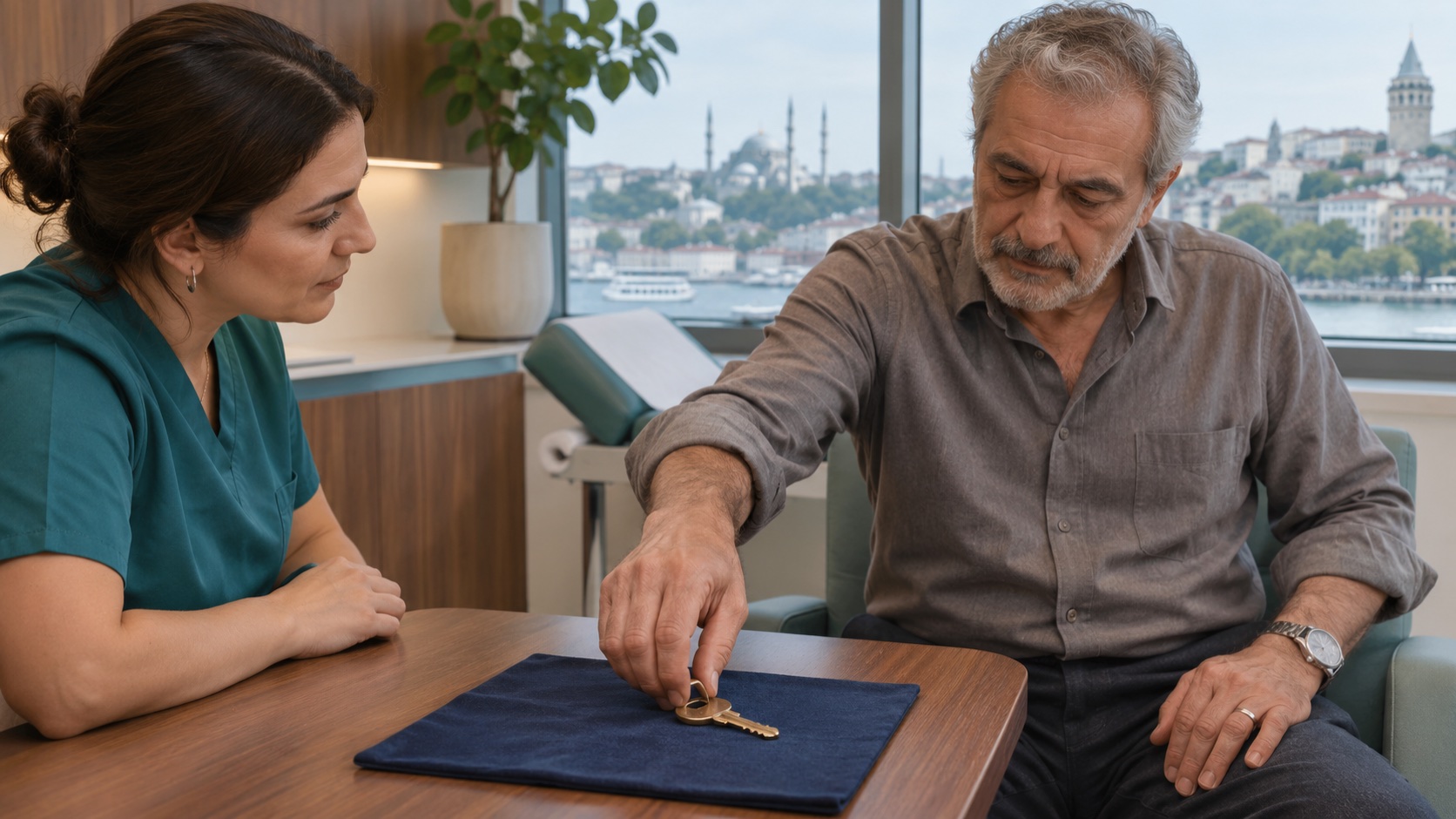
If buttons have become unexpectedly difficult, objects keep slipping from your hands, or your walking has become less steady, mention those changes even if your neck hardly hurts. They can be signs of degenerative cervical myelopathy, a condition in which narrowing in the neck affects the function of the spinal cord. A scan showing a narrow canal and a person developing spinal cord symptoms are different clinical situations. The decision about cervical spinal stenosis surgery begins with the neurological examination, the pace of change and whether the imaging explains the loss of function. 1, 2, 3
Why a problem in the neck can affect the legs
The cervical spine is the part of the spine in your neck. The spinal cord runs through its central canal, carrying messages between the brain and the arms, trunk, legs and pelvic organs. Smaller nerve roots leave the canal through openings at the sides. Pressure on an individual root can produce pain, tingling or weakness in part of an arm. When the cord itself is affected, problems can extend well below the neck and involve coordination, leg stiffness and balance as well as hand function. The two problems can coexist. 1, 2
Over time the discs may lose height or bulge, bony overgrowth can develop near the joints, and ligaments can thicken. In some people a ligament at the back of the vertebral bodies becomes ossified. Others start with less room in the canal because of its natural shape. These factors can reduce the space available for the cord. The level and direction of the pressure, the position of the neck and the amount of space behind the cord all matter when the team considers how to relieve it. 2, 7, 8
A report may mention cervical spondylosis, canal stenosis, cord contact or signal change. Spondylosis describes wear-related changes. Stenosis describes an anatomical narrowing. Myelopathy describes impaired spinal cord function. The three terms do not mean exactly the same thing. Some people have significant-looking narrowing without clinical myelopathy. Others have subtle but important examination findings despite an unremarkable appearance from across a room. Ask your specialist to show how the scan and the neurological findings fit together before deciding what a particular phrase in the report means for you. 2, 3, 4
Changes worth bringing to medical attention
Hand symptoms can start with everyday tasks. A musician may miss familiar movements, a parent may struggle with small fasteners, or a person who writes for work may notice less controlled handwriting. Some people describe numbness in several fingertips or difficulty distinguishing a coin from a key in a pocket. Notice whether the change affects one hand or both, whether it is getting worse, and whether your grip or coordination is the main problem. A painful thumb joint that limits pinching is a different clue from repeatedly dropping a mug despite being able to hold it. 1, 2
Walking changes can be harder to recognise in yourself. Someone close to you may notice that you reach for walls, hesitate on uneven paving or take shorter, stiffer steps. Descending stairs or walking in a crowded street can become difficult before walking across a quiet room does. A change in hand skill together with a change in gait deserves prompt medical attention. Tell the clinician about falls, when you started using a rail and whether your balance has changed independently of leg pain. 1, 2
Seek urgent local care if weakness or walking deteriorates rapidly, if you suddenly cannot walk safely, or if new bladder or bowel dysfunction occurs with neurological changes. After an injury, new weakness, numbness or loss of movement needs emergency assessment. A sudden one-sided deficit, facial droop or speech disturbance can also indicate a stroke and should trigger emergency help. Do not wait for an international appointment or an email response about new rapidly changing neurological symptoms. A planned record review is suitable for stable questions once immediate safety has been addressed. 1, 2, 9
Distinguishing spinal cord compression from other causes
A pinched cervical nerve root, called radiculopathy, often causes pain radiating from the neck towards a shoulder or arm, sometimes with weakness or altered sensation in a particular distribution. It does not by itself explain stiff legs and a progressively unsafe gait. Carpal tunnel syndrome or ulnar nerve irritation can affect the hand, and the same person may also have cervical cord compression. If a wrist treatment improved some tingling but buttons and balance continue to deteriorate, describe both the improvement and what remains. 1, 2
Lumbar stenosis can cause heavy legs brought on by standing and walking, often relieved by sitting or leaning forward. It would not ordinarily explain new hand clumsiness. Some people have narrowing in the neck and lower back at the same time. Others have peripheral neuropathy, a vitamin deficiency, a neurological disorder or joint disease that also affects movement. The aim is to identify which change is attributable to which condition before deciding what should be treated first. How lumbar stenosis affects walking. 1, 2
What the examination and MRI need to establish
Bring a short timeline. Include the last time you could manage a particular task comfortably, the first fall, and any recent worsening. List previous wrist, shoulder, neck or lower-back treatment and which symptoms it changed. A relative's observation can help if the difference has developed slowly. The clinician assesses strength, sensation, reflexes, hand dexterity and gait. Some reflexes may become unusually brisk below the level of cord dysfunction. No single sign confirms or excludes myelopathy, particularly early in the course. 1, 2
MRI of the cervical spine is the main imaging examination when degenerative cord compression is suspected. It shows where the canal narrows and checks the cord, discs and surrounding soft tissues. A change of signal within the cord can inform the discussion about injury and prognosis. The presence, absence or extent of signal change cannot by itself establish severity or predict exactly how much function a person will recover. Imaging needs to be interpreted alongside the examination, daily limitations and the speed at which those limitations are changing. 2, 4, 5
CT provides more detailed information about bones and ossified ligaments and may be useful in selected surgical planning. Standing or motion X-rays can clarify alignment or suspected instability when it is safe and clinically appropriate to obtain them. Electrical studies may help distinguish a peripheral nerve problem from root disease if the picture is uncertain. They do not replace assessment of the cord on MRI. Before arranging another test, ask which uncertainty it will resolve and how the answer could change your treatment. 2, 7, 8
Ask about severity in terms of function. Specialists may use the modified Japanese Orthopaedic Association score, or mJOA. It considers upper- and lower-limb function, hand sensation and bladder function. Common categories are mild at 15–17, moderate at 12–14 and severe at 11 or below. These categories help clinicians compare similar groups and plan follow-up. A small numerical change can still matter if it means a person can no longer do the hand work their profession requires. A clinician should determine the score and interpret it in context. 3, 5
Observation, rehabilitation and when surgery is recommended
If MRI shows cord compression but the person has neither clinical myelopathy nor radicular symptoms, international guidance generally advises against routine preventive surgery. The important next steps are to discuss the possibility of progression, learn which changes require review and agree clinical follow-up. The decision is different if root symptoms are present as well, because the risk of developing myelopathy is higher. Ask what the reviewing clinician found on the examination and which change would shift the balance toward an operation. 3
For mild, stable myelopathy, options may include surgery or a carefully supervised and structured trial of rehabilitation with close reassessment. This requires a credible plan for recognising neurological deterioration. If function worsens during nonoperative care, guidelines recommend operative intervention, and persistent lack of improvement also justifies another surgical discussion. A September 2026 AO Spine review examines how to define mild disease and counsel patients about its variable course. For an individual, subtle disability, other illnesses and the feasibility of timely follow-up matter alongside the severity category. 3, 4, 5
Moderate or severe degenerative myelopathy is generally an indication to offer surgery when the health and preferences of the patient allow it. The main goal is to relieve pressure and reduce the risk of further neurological decline. Some patients regain hand skills or steadier walking, while others mainly preserve the function they still have. No operation can guarantee recovery of cord tissue that is already damaged. If function is worsening, ask for timely specialist evaluation even when the pain seems mild or exercises have temporarily eased neck stiffness. 2, 3, 4
Physical or occupational therapy can help with safe mobility, fall prevention, assistive devices and tasks around the home. In someone being monitored, the therapist needs to know that cord compression is suspected or established. Forceful neck manipulation is inappropriate in this setting. Pain medication can make daily activity more tolerable but does not create more space for a compressed cord. Avoid using relief of neck pain as the sole measure of whether the underlying neurological condition is stable. 1, 2, 3
Anterior surgery, laminoplasty and posterior fusion
Anterior cervical discectomy and fusion, abbreviated ACDF, approaches the spine from the front of the neck. The surgeon removes the affected disc and relieves pressure from degenerative tissue in front of the cord or a nerve root. The selected level is then supported for fusion. The method can be useful for focal front-sided compression and when restoring the shape of a segment is important. Ask the surgeon to show which levels need treatment and whether pressure is mainly at the disc space or behind the vertebral body. 7, 8
Where compression extends behind the vertebral body, another anterior procedure, a corpectomy, may be discussed. It involves a more extensive reconstruction, so the reason for choosing it over disc-level surgery should be clear. Anterior operations can cause temporary swallowing difficulty or voice change. Other risks include failure of the fusion to heal, implant problems and injury to structures near the approach. The number of levels, prior surgery and individual anatomy can change the balance between an anterior and a posterior plan. 6, 8, 10
Laminoplasty expands the canal from behind while retaining and repositioning part of the bony arch. It is mainly considered for selected multilevel compression in a neck with maintained lordosis, enough stability and limited prominent mechanical neck pain. The curvature matters because the cord needs room to shift away from structures pressing on it from the front. A fixed kyphotic neck or important instability may make laminoplasty less suitable. It aims to preserve some movement, but stiffness, reduced range and persistent neck discomfort can still occur. 7, 8
Posterior laminectomy provides space by removing the bony roof over selected levels. When alignment or stability requires support, it can be combined with instrumented fusion. In a carefully selected patient with adequate stability a decompression plan may differ. Ask why fixation is proposed, how much movement would remain, and what could happen to alignment over time without it. A combined approach from the front and back is considered in selected complex cases. It has greater surgical demands and needs a specific anatomical or stability-related justification. 7, 8
How to interpret comparisons between approaches
A randomised trial published in JAMA compared anterior and posterior operations in 163 selected patients with multilevel cervical spondylotic myelopathy. At one year it found no statistically significant advantage for the anterior approach in the primary measure of patient-reported physical function. The pattern of complications differed. The trial included people for whom either approach was considered reasonable. It does not show that all techniques are interchangeable when a person has pronounced kyphosis, focal anterior compression or instability. 6
When two opinions differ, ask that both plans be drawn on the same MRI and alignment films. Compare where the cord will gain space, what happens to the neck's curve, whether fusion is needed, and which complication each team thinks matters most for you. Someone who relies on head rotation for work may put particular weight on retained movement. Someone with substantial swallowing difficulty before surgery may need that issue assessed while the approaches are discussed. Document those priorities alongside the changes you most want to prevent. 4, 6, 7
Preparing for surgery and recognising complications
Ask about infection, bleeding, new neurological deficit, fluid leakage from the covering around the cord, persistent symptoms and the possibility of further surgery. Weakness around the shoulder or upper arm, sometimes called C5 palsy, is a recognised complication of cervical decompression. Fusion introduces separate healing and implant risks. A front-of-neck approach makes swallowing and airway symptoms particularly important. The treating team can explain how anatomy, number of levels, frailty and an existing voice or swallowing problem alter your individual risk. 7, 8, 9, 10
Before admission, provide a list of medicines, allergies, blood thinners, relevant conditions and previous neck or throat surgery. Tell the anaesthesia team about sleep-related breathing problems or any previous difficulty with airway management. Describe how you normally walk, what aids you use and who will accompany you home. Think about practical safety, including bathroom access, stairs and how you will call for help if your hands are clumsy. Request written medication instructions and a plan for any assessments needed before the operation. 8, 9, 10
After surgery the team checks strength, sensation, walking, wound condition and pain control. After an anterior procedure it also pays close attention to swallowing, voice and breathing. New or rapidly increasing neck swelling, breathing difficulty or severe difficulty swallowing needs emergency assessment. New weakness, worsening gait or loss of bladder or bowel control also deserves urgent medical attention. Increasing redness, fever or wound drainage needs prompt advice. Clarify before discharge which number to use for planned questions and where to obtain urgent local help. 9, 10
Recovery at home and preparation for Istanbul
Wound healing and neurological recovery take different courses. Arm pain may ease before hand coordination improves, and balance training may remain important after a good surgical decompression. A physiotherapist can help with safe walking, while an occupational therapist can address tasks such as dressing and meal preparation. Use a task relevant to you to record progress, such as handling cutlery or negotiating the steps at your front door. Improvement can be gradual; a new decline should prompt review even if another symptom has improved. 1, 4, 9
A collar is prescribed selectively according to the operation and surgeon's plan. Ask when to wear it, whether help is needed to manage it and how skin or fit should be checked. Driving requires safe movement, attention and the ability to control the vehicle without impairing medication; discuss medical and insurance requirements. A desk job, a job lifting people and a job requiring work overhead pose different demands. Ask for return guidance for your actual duties and the journey both ways, including any fall risk on public transport. 9, 10
For an opinion in Istanbul, gather your full cervical MRI in DICOM format and its report, available standing radiographs or CT, past operation reports and a brief symptom timeline. Say when you last wrote, dressed, walked or used stairs normally, and note new falls or bladder changes. Include the results of any assessment for carpal tunnel syndrome or another neurological condition. If you are worsening rapidly, obtain local assessment first. A remote review can identify questions for consultation but cannot replace a hands-on neurological examination. 1, 2
Recmed Medical Travel can coordinate a request for assessment in Istanbul. Before travel, clarify how to share the original images, which questions still require examination, whether interpretation is needed and who would supervise recovery at home. Request a written individual quotation after the hospital has assessed the likely procedure. Ask how an extended stay or a change in approach would affect it. For the return journey obtain the operative report, implant details where applicable, a medication plan and written advice about wound review, flying and follow-up. Plan a spine consultation in Turkey. Request a review of your records.
Questions families often ask
My neck feels fine. Could changes in my hands still be related?
Yes. Neck pain may be mild or absent when cord function is affected. Explain which tasks have changed, whether changes involve one or both hands and whether your walking or bladder function has changed as well. A clinician may find a hand or peripheral nerve condition, cord dysfunction, or a combination. Prompt assessment is especially important if coordination is deteriorating. Waiting for neck pain to become severe can delay attention to a problem whose first clues are in the hands or legs. 1, 2
Does the absence of a bright spot inside the cord mean it is safe to wait?
A lack of obvious signal change does not establish that a symptomatic person is safe to observe indefinitely. Likewise a bright area on MRI does not determine the entire plan on its own. The team weighs function, examination, pace of change and the pattern of compression. If observation is chosen, leave with a date for reassessment and a way to report deterioration sooner. Write down what you can currently do with your hands and how confidently you walk so later changes are easier to recognise. 2, 4, 5
Will decompressing the neck also fix narrowing in the lower back?
Neck surgery cannot enlarge the lumbar canal. Cervical cord compression can contribute to leg stiffness and balance problems, while lumbar nerve compression may cause a different pattern of leg symptoms. In a patient with both, improving cord function may make one part of walking easier while another remains limited. Ask which symptoms each level plausibly explains, which requires priority and what outcome would prompt reassessment of the other. A staged evaluation can clarify the next decision after the more urgent problem is addressed. 1, 2
How can my family help if I choose close follow-up for mild myelopathy?
Agree on ordinary changes worth mentioning, such as needing help to button clothing, dropping objects increasingly, using a rail on previously easy stairs or experiencing new falls. Family members can note dates and help arrange an earlier appointment. Frequent home strength tests or risky balance challenges are unnecessary. Ask the specialist which change needs emergency assessment, which needs a prompt call, and when the next examination will occur even if nothing seems to have changed. 1, 3, 5